Caregiver Self-Care Toolkit
No one can be “on” 24/7. At the end of the day, it is likely that first responders and their families are going to have incredibly hard days. One cannot merely “grin and bear it” through a pediatric fatality, or smile and wave when being scrutinized in the court of public opinion. Similarly, being the non-first responder caregiver in a first responder household has its own challenges. Your responsibility is to fill the gaps when duty calls.
Staying grounded as a caregiver requires realistic expectations and self-awareness. When stress from work begins to spill into home life, the most important step is to recognize it and respond intentionally. Children learn by watching the adults around them. Attempting to bury feelings of sadness, anger, frustration, guilt, or fatigue can unintentionally shift that emotional burden onto your child. Rather than striving to “leave work at work,” consider this: What would you have wanted someone to teach you as a child about handling uncomfortable or overwhelming emotions?
The most effective way to support children emotionally is to model coping skills in real time—first by showing them the skill, and then by guiding them in using it themselves. Below are a few examples of healthy, realistic ways to work through the difficult moments and transitions that come with life in a first responder household.
Process the Day as it Happens
Taking intentional breaks throughout the day to practice self-care is often far more beneficial than waiting to release stress all at once at the end of a long shift or day. While many people believe it’s not possible—or worry that others may judge them for stepping away—those assumptions are often unrealistic and unhelpful. In reality, even just two minutes to pause, breathe, and ground yourself in the present moment can make a meaningful difference in how you manage the rest of your day.
Small, consistent moments of self-care can help reset your mindset, regulate stress, and improve your ability to show up—both at work and at home. It’s not about stepping away for hours; it’s about recognizing when your internal pressure is building and giving yourself permission to release a little of it before it becomes overwhelming.
Below are options to process stress throughout the day:
- Take a few minutes every hour to intentionally release the tension in your body (unhinge your jaw, roll and relax your shoulders, rotate your neck slowly from one should to the other, etc.)
- Recognize as quickly as possible when you are experiencing changes in your body, or thought patterns, these are good indications that you are experiencing stress. It is important to consider where the stress is coming from, and if it can be managed through actions you can take while still at work.
- Is there someone you can quickly, and appropriately, decompress with at work?
- Doing pushups
- Progressive muscle relaxation to quietly let the tension out
- Putting in headphones and listening to your favorite song
- Smelling something that is associated with positive memory
- Tactile Breathing
- Playing a quick game on your phone (Candy Crush, Wordle, etc.)
- Sitting with your head back and your eyes shut
- Stretching
- Jumping
- Running up and down a flight of stairs
- Identify yourself, either by writing it down, or saying out loud the emotion you are feeling, why you are feeling that way, and how you will get through it.
- Is there a quiet space where you can take 10 minutes to allow yourself to fully feel the emotions you are feeling? Research shows that if you stay on one emotion and allow yourself to feel it fully, while not allowing other thoughts to pull you away from that emotion, you will only experience it for 90 seconds.
- Is there someone you can quickly, and appropriately, decompress with at work?
- Set appropriate boundaries; there are laws around how much we are allowed to work because no one can keep going forever. Breaks from your work life, or breaks from the demands of home life, can be essential if you are at the end of your rope.
- Being contacted: Do you need to take your email off your personal devices? Or, put your work cell phone across the room so that you can still hear it, but you will not feel as compelled to scroll through it. Do you need to set parameters for what constitutes being contacted after hours?
- At work, do you have the ability to close an office door or move to a quiet area to focus if you need to get work done?
- Skip the No: This may come as a surprise, but one rule for parents around setting boundaries is clear: Only say no when you mean it. This is essential for raising children with as few arguments as possible. If your child asks for something safe, but not necessarily part of their standard routine, it is okay to say yes, especially if you are too spent to stick to the no. Can I have extra tablet time? Can I have ice cream for dinner? Can I go to bed after this movie is done? All of these questions can be met with a yes, once in a while. The key is consistency. If you say no and then change to a yes after there is yelling, tantruming, repeated questions, etc., then your child knows that they just need to push through the no to ultimately get to what they want. Instead, when your child asks you a question and you do not have a clear rationale for why they can’t do it, allow yourself to say “Today is a special day, so I am going to say yes,” especially if it will allow you the space to regulate. For example, extra tablet time means you may be able to take an uninterrupted shower. Ice cream for dinner is a lot less effort than cooking, and sugar highs do not last forever. Please note that the key is to do this sparingly. If you become too lenient too often on rules you would like your child to follow, then your child may keep pushing the boundary or have difficulty reverting back to their routine.
Tips for Transitioning from Work to Home
Decompression Buffer
Use your commute home to engage in the present moment and promote relaxation of your nervous system.
Potential Options:
- Spray a smell you particularly like in your car to signal to your brain that your day is over.
- Have a playlist ready to go that elicits positive emotions or allows you to process negative emotions in a regulated way.
- Listen to a podcast that is light hearted and funny (Dr. Winch’s favorite is called We’re Here to Help), or interesting
- 5–10 Minute Rule: Sit in your car, garage, or driveway before entering the house. Use that time to breathe, listen to music, pray, or sit in silence.
- “Changeover Ritual”: Change clothes immediately when you get home to symbolically leave work at the door (and for sanitation if you’re a first responder)
- “Wash off the Day”: Take a shower with the intention of wahing off the day in the process
- “Leave it at the Door”: Some people have rituals where they make a conscious effort to leave the stress of the day at the door
- Challenge Coin: some people will carry a challenge coin in their pocket and then leave it in a spot by their front door to symbolize that everything from work is being left behind with the coin
- Hang it on the Tree: some people will intentionally say that they are hanging the stress of the day on a tree outside their home and they will pick it up the next day
- Acknowledge your family and then take time for yourself
- The Hug and Go: Give everyone in the family a hug, and then go take time for yourself. “I missed you. I need a quick minute, and then I’ll be ready to hear about your day.”
It is important to point out that children learn emotion regulation and problem-solving by watching their caregivers navigate the world. The more you can teach them that emotions are okay and actions are controllable, the quicker they will be able to learn and integrate these skills into their own lives.
Planning for the Stressful Days Before They Happen
We all get overwhelmed, and we all have days that feel like a never-ending series of problems. On these days, our capacity to be emotionally available to others is going to be diminished if we try to push through without taking the time to address our needs. If we ignore our needs when we are running on empty, we are more likely to engage in regrettable behaviors (e.g., yelling at our kids, being overly strict, or maybe just being emotionally absent). The key to getting through the “suck” is to develop a plan in advance so that everyone knows how to help each other. If you do not have a plan, then people tend to help each other the way they want to be helped, and that is where problems can start. For example, young children need the help of adults to regulate their emotions, so in their times of stress, they will most likely go to a trusted adult. As a result, they may think that adults need the same and respond to signs of stress with closeness that may come across as clinginess. For many people, this clinginess is the opposite of what they need in their moments of overwhelm. Here is what you can do:
Creating a Self-Care Plan
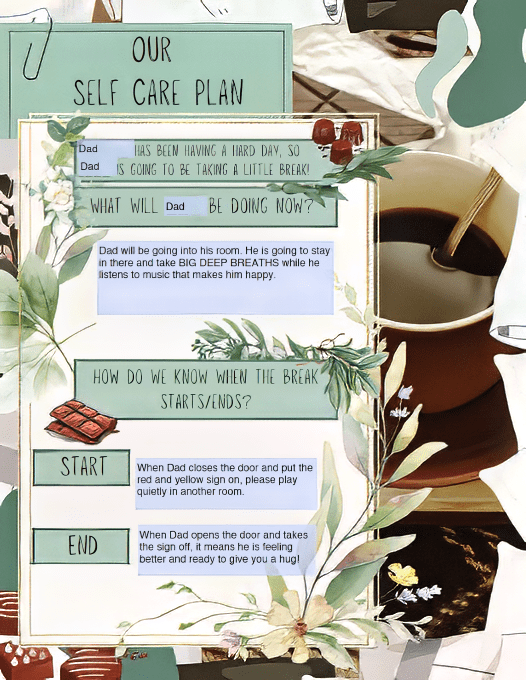
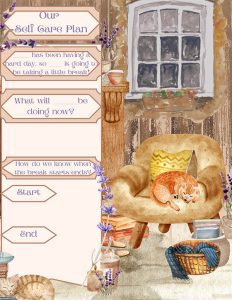
A Self-Care Plan is for everyone in the family. It helps each person think about what they need in advance of a problem and allows the other family members to know how to respond in the most productive way possible. Here is an example of a Self-Care Plan:
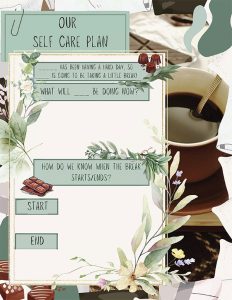
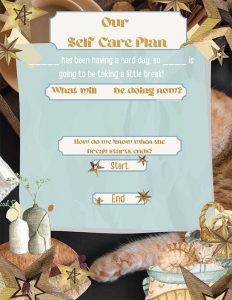
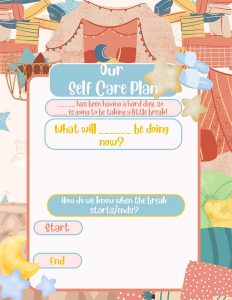
Below are downloadable versions of self care plans that you can do with your family!

How to Navigate Your Level 10 Day
What is a Level 10 Day? A Level 10 Day is a day where you cannot “Just shake off.” Whatever is happening feels too overwhelming that quick regulation techniques will not be effective. Dr. Winch and her husband developed this plan and use it whenever they need it. The plan was created as a guide for her and her husband to communicate that they are struggling without needing to get into the details.
Creating a Level 10 Day Plan – A major theme of the resources provided is that it is okay not to be okay. Our emotions are what they are, and it is acceptable to feel whatever you are feeling. However, your actions as a result of your feelings may become problematic if you do not address your feelings appropriately and in a timely manner. Here is an outline of questions to go through with your loved ones at a neutral time so everyone knows what you will be doing and what they can be doing to be supportive.
- Make a code word: What is the code word that you can say or text that lets the people in your family know that you are in an intense state of heightened negative emotion?
- Create a game plan: What is it that you expect your loved ones to do to help you?
- How will YOU get yourself through this experience? It is not fair to expect others to be responsible for your self regulation. It is essential that you find a way to de-escalate the sensations and emotions that you are having. Below are examples of ways that you can calm yourself quickly when experiencing distress. These strategies are taken from Dialectical Behavioral Therapy, and are proven to help regulate the nervous system:
- Deep Breathing – Deep breathing is a tool that can be used anywhere and anytime. Taking slow and controlled breaths signals to your brain that you are safe and can allow you to relax.
- Breathing Techniques that Work: Tactical Breathing (Box Breathing)
- Remember 4-4-4-4 – Breathe in for 4 seconds, hold for 4 seconds breathe out for 4 seconds, hold for 4 seconds, repeat
- Cyclic Sighing
- Directions: Breath in through your nose and fill your lungs. Then take a second inhale, focusing on expanding your lungs as much as possible. Then exhale through your mouth in a slow and controlled way. For more information, see the Stanford Medical article.
- The 4-7-8 Technique
- 4 – Inhale for a count of 4
- 7 – Hold your breath for a count of 7
- 8 – Exhale through your mouth for a count of 8
- Breathing Techniques that Work: Tactical Breathing (Box Breathing)
- Deep Breathing – Deep breathing is a tool that can be used anywhere and anytime. Taking slow and controlled breaths signals to your brain that you are safe and can allow you to relax.
- Ice – While cold plunges have been all over social media lately, ice therapy has been around for many years. By taking a cold shower, sticking your head in ice water, or going into an ice bath, your parasympathetic nervous system will be triggered. This is the system that is responsible for allowing your body to relax. Please make sure to consult with your doctor to determine if cold therapy is an option for you BEFORE you try it.
- Exercise – When we engage in exercise, especially exercise that gets our heart rate up, our brains release the chemicals needed to experience positive emotions. This is what is behind the term “runner’s high.” Now, you do not need to run a marathon to experience these positive effects. Find something that you enjoy doing and do it. Dr. Winch has found anything from a jump rope, some push ups, or jumping on a small trampoline for 10 minutes to be enough to shift her out of heightened levels of distress. As with cold therapy, it is important to discuss what you can and cannot do with your doctor BEFORE engaging in this emotion regulation approach.
Other Strategies to Promote Family Cohesion
- Visual Schedule (Even if It’s Ugly):
Write down a loose structure for the day-kids respond to predictable anchors. - Color-Coded Energy Blocks:
Use red (you need a break), yellow (you’re hanging in), green (you can be fully present). - Tag-Team with Your Partner (if possible):
If they’re off shift, divide and conquer-don’t expect them to jump in 100% after trauma or exhaustion.