Chaplaincy – Lonnie Crawford
Transcript
Hello, my name is Lonnie Crawford. I′m a fire chaplain and also a retired firefighter. The chaplaincy is all about relationships and relationships are all about time. As one more wellness tool, chaplains spend time investing in the lives of first responders earning a place as a trusted, confidential resource. Spending decades of your life serving the community on their worst day may take a toll on the spiritual framework that make up so many first responders. Chaplaincy can often provide a path to regaining that compass through compassion and spiritual guidance. This module will give you an overview of the chaplaincy, but also specific steps to take to begin or expand your chaplaincy program.
Chaplaincy – Course Chapters
1. Chaplaincy Overview
Audio
Transcript
Building Your Chaplaincy Program
BUILDING YOUR CHAPLAINCY PROGRAM. In this module, we will discuss how to build your chaplaincy program.
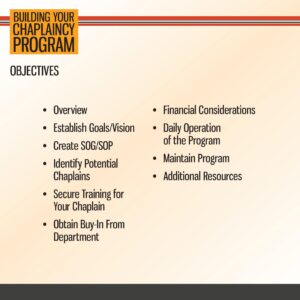
At the end of this module, you will have an overview of what chaplaincy is, why chaplaincy is needed, and who makes a good chaplain. You will also begin to establish your goals and vision within the chaplaincy. We will discuss how to build your standard operating procedures, how to identify potential chaplains, training opportunities for your chaplains, how to obtain the necessary buy-in for your program, financial concerns, how to run the operation on a day-to-day basis, what you can do to maintain your program, and some additional resources that you may want to consider when starting your chaplaincy program.
Chaplaincy Overview
The upcoming content will discuss a brief history of chaplaincy, what the chaplaincy is, why it is needed, and who makes an effective chaplain.
What is the Chaplaincy?
Prior to discussing how to build your chaplaincy, it may first be important to note the history of the chaplaincy and what that means in today’s terms. The history of the chaplaincy goes back to the 4th century when a Roman soldier who was on his way to war, stopped to care for someone who was known during that time as a “beggar.” The soldier could not give up his equipment, but instead cut his cape in half and offered it to keep the person warm. His cut cape became a relic placed in a chapel. Chaplains were charged with guarding the relic and continuing the commitment to care for others. First responder chaplaincy is a form of ministry that is focused on assisting those who are first responders, such as firefighters, police officers, and emergency medical personnel. Chaplains provide emotional and spiritual support to these first responders, allowing them to better cope with the challenges they face in their line of work. They also provide counseling and other forms of assistance to the families of those first responders who have been injured or killed in the line of duty. Lastly, chaplains often provide support to the members of your community who have been affected by loss and tragedy. At its core, the chaplaincy is all about building relationships and caring for those in need.
Why is the Chaplaincy Needed?
Everyday, the men and women who serve as first responders put their lives on the line for their communities. The work they do is full of unique challenges like dealing with extreme physical conditions and coping first hand with human tragedy. Often these challenges take a toll on their well-being and put incredible strain on their relationships. The chaplaincy plays an essential role in providing support and comfort to these men and women in times of need, particularly when they are facing difficult life situations. Chaplains are trained in pastoral care and are able to provide a listening ear, spiritual guidance, and prayerful support. They can help to promote emotional and spiritual well-being, which can lead to greater resilience and improved mental health. Chaplains also provide links to other support services, such as counseling, and are an important part of many first responder agencies.
2. Implementing a Program
Audio
Transcript
Who is a Chaplain?
People arrive at the chaplaincy from a variety of starting points. Some are current or former first responders who are committed to supporting their brothers and sisters. Some are members of the clergy who are passionate about being there for this amazing group of people. Ultimately, a good first responder chaplain should have strong listening and communication skills, be understanding and empathetic, and have a deep knowledge of spiritual practices, traditions, and beliefs. They should also have a strong understanding of trauma, grief, and crisis counseling and be comfortable working in high-stress environments. Additionally, a first responder chaplain should be able to approach people from all walks of life and religious backgrounds with respect and acceptance. Three key characteristics are essential when considering the chaplaincy.
They are: 1. Being Available – first responder chaplains must be available to respond to the department’s needs.
While much can be done in a scheduled, proactive manner, some of the work of the chaplaincy, just like the first responder profession, is done in response to emergency situations. Chaplains with other responsibilities will always have to balance the department’s demands with the demands of their time.
2. Being Visible – the chaplain must be committed to being around. This is the proactive side of the chaplaincy. The chaplain becomes embedded within the department through station and unit visits, one-on-one contacts, and department functions.
3. Maintaining Confidentiality – the chaplain must maintain the strictest level of confidentiality with the department’s members. This one characteristic has the power to make or break the success of your chaplaincy program.
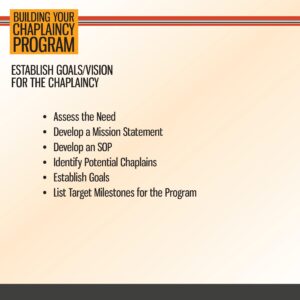
Establishing goals and a vision for a first responder chaplaincy program is a great way to ensure the program is successful. The first step is to assess the needs of your agency. This could include talking to emergency responders, chaplains, and other stakeholders to determine what would be most beneficial for the program. Once the agency’s needs have been identified, it’s important to develop a mission statement for the program. This statement should include the purpose of the program and how it will be implemented. Next, develop your programs standard operating guidelines. These will address much of how the program will run.
Additionally, it’s important to establish short and long-term goals for the program. These should include specific objectives and strategies to measure the program’s success. Lastly, creating a vision of what the program hopes to achieve in the future is essential. This should include a timeline and milestones to help track progress. By establishing goals and a vision for the program, you can ensure that it will successfully meet your agency’s needs.
First responder chaplains provide spiritual care and comfort to responders themselves, their families, and crisis victims. While a first responder chaplain will bring their faith traditions and beliefs as a basis for their chaplaincy, they are able to connect with and support those of many different faiths or of no faith. Chaplains lend an ear to those who need to talk about challenges they are facing, professionally or personally, and do so in a confidential manner. A chaplain’s goal is to aid, comfort, and help first responders, their families, and crisis victims, as well as to refer them to vetted resources for additional assistance.
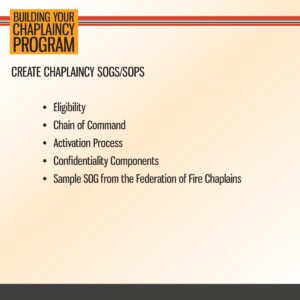
Create Chaplaincy SOGS/SOPS
Developing standard operating procedures for first responder chaplains can be a complex task. To ensure success, it is important to start by consulting with the chaplains themselves, to understand their roles and responsibilities. Next, review existing policies and procedures related to the chaplaincy, including any governing laws, regulations, and standards. From there, you can develop your own standard operating procedures that are tailored to the specific needs of the chaplains and the organization. As you create the procedures, ensure that they are clear, concise, and easy to understand. Additionally, be sure to include regular reviews of and updates to procedures, to ensure that they remain relevant and accurate.
Finally, be sure to communicate the new procedures to all chaplains and to provide any necessary training or support they might need to implement the policies. With the right preparation and attention to detail, you can develop effective and efficient standard operating procedures for your first responder chaplains. Some components to consider when writing your standard operating procedures or guidelines should be: Eligibility – Does the chaplain need an outside ecclesiastical endorsement? Does the chaplain need prior first responder experience? Chain of command – Where does the chaplain fit within the rank structure? Who does the chaplain directly report to? Activation process – How is the chaplain notified of emergency events?
How do members of the department notify the chaplain directly? Can the chaplain be contacted by family members? Confidentiality – What is the expectation of department leadership about what the chaplain will communicate to them after meeting with a member? Is there clear language expressing the confidential nature of communications with the chaplain? A great example of this can be obtained from the Federation of Fire Chaplains. This will be provided to you in the Chaplaincy Task book attached to this module.
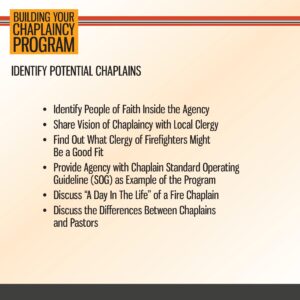
Identify Potential Chaplains
Potential first responder chaplains can be identified by looking for individuals in the community who have a strong faith and are willing to serve in that capacity. They should have strong listening skills and the ability to provide spiritual guidance and comfort to those in crisis. They should be able to work well with first responders, law enforcement, and other emergency personnel. They should also be able to work well with people from a variety of backgrounds, religions, and cultural beliefs. Finally, they should understand the legal and ethical issues that may come up in their role. Here are some ways to identify potential chaplains:
- Identify people of faith inside the agency. Since the chaplaincy is a faith-based role, those inside the agency who have a faith foundation may see an opportunity to more formalize their connection and spiritual support within the agency.
- Share the vision of chaplaincy with local clergy. This would allow those outside of the department to get a glimpse into the first responder world and to see if they might see it as a place of service.
- Find out what clergy of first responders might be a good fit. First responders who are part of faith communities would have a good understanding of whether or not their faith community leader would be a good fit to work with first responders.
- Provide the agency or congregation with chaplain standard operating guidelines as example of the program. These guidelines should provide a clear, detailed description of the role of the chaplain which may allow the entity to identify people to fill this role.
- Discuss “a day in the life ” of a first responder. This would allow someone to get insight into the daily working of a chaplain to determine the degree to which they see a connection.
- Discuss the differences between chaplains and pastors.
Since these are two very different roles with very different skillsets, this discussion would help to further clarify potential chaplains. Some of these differences include:
–– Pastors often have little training in crisis ministry
–– Pastors often talk in sermons and other public speaking venues
–– Pastors are often the focus of attention
–– Pastors are often the primary leader
–– Pastors can be forthright with their beliefs
By contrast –– Chaplains have extensive training in crisis ministry
–– Chaplains are usually listening
–– Chaplains are generally in the background
–– Chaplains are usually in a subordinate position
–– Chaplains wait to be invited to share their beliefs
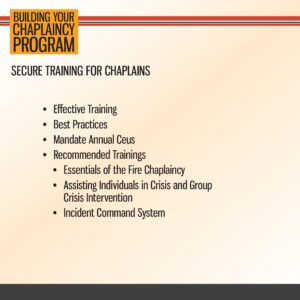
Secure Training for Chaplains
As a defined, professional role within the first responder department, the training of chaplains is crucial. Education is an important part of all the Toolkit components, and ensuring that your chaplains are armed with the knowledge and tools they need will allow them the best chance to succeed. When identifying the most effective training for your chaplains, consideration must be given to the following: Identify the training considered to be best practice for chaplains. Continually seek out what best practices entail. Best practices may change, but staying involved and connected will help you to grow with these changes. The training you provide your chaplains will provide them with a foundation of work. The trainings listed should be a part of every chaplaincy program. A list of these programs can be found in the resource and task book section of the chaplaincy module. In addition, it is important to develop and maintain a way to track continuing education units for chaplain training. This ensures that training is consistently and effectively administered.
3. Buy-in and Maintenance
Audio
Transcript
Obtain buy-in from Department
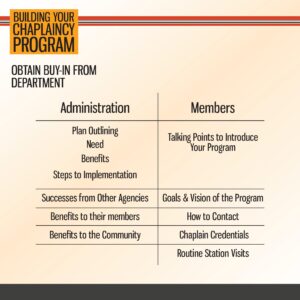
When starting a new chaplaincy program, it is important to work to create buy-in from the department. The chaplaincy may be a foreign concept to many in the organization. The best way to do so is to present a well-researched plan outlining the need for such a program, the potential benefits, and the steps needed to implement it. Presenting data from similar programs that have been successful in other jurisdictions can be especially helpful in getting the administration on board. Additionally, be sure to explain how the program could help first responders and their families, such as by providing emotional support, increasing morale, and improving overall well-being. Finally, it’s important to demonstrate how the chaplaincy program could help the organization achieve its goals and strengthen relationships within the community. By providing a compelling case for the program, you should be able to obtain the necessary buy-in from your administration. You must also think about how the chaplaincy will be received by the members of the department.
For some, the chaplain will become a kind, encouraging figure who they interact with from a distance. For others, the chaplain will become a resource for wisdom and comfort. For yet others, the chaplain will become a resource for matters of spirituality and faith. It would be helpful to develop a list of talking points to be discussed when introducing the program to the members of your agency. Included would be the goals and vision for the program, ways to contact the chaplain, and credentials of the chaplain. Further, it is imperative for the chaplain to conduct routine station visits to meet the members in a comfortable setting. Ideally, these visits would include a chief officer who could introduce the chaplain to the department. If this is not possible, an email introduction could be utilized.
Financial Considerations
Financial considerations for chaplaincy can vary depending on your agency’s circumstances. Generally, a chaplaincy program requires a financial commitment. This can include training costs, travel expenses, duty and dress uniforms, radio, phone and business cards. You will need to determine if the chaplain will be a volunteer or a paid department member. If the chaplain is a volunteer, consideration should be given to offering a stipend. It is important to research the type of chaplaincy you are interested in and to clearly understand any associated costs before embarking on the journey. By connecting with other jurisdictions in your area, you may have an opportunity to see what costs they incur with their programs. For a list of fire service specific chaplaincy programs to connect with, see, floridafirefightersafety.org. For more information about law enforcement chaplaincy resources and programs, contact the International Conference of Police Chaplains. Through these resources, you can connect with established chaplaincies in your region.

Daily Operation of Program
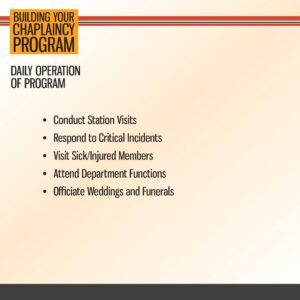
The daily role of a chaplain is primarily focused on building relationships with first responders. This can involve making regular station visits to get to know the members. By conducting routine station visits, the chaplain will allow the members time to learn about the chaplain and the program in a relaxed, comfortable setting. The chaplain will conduct other functions such as visiting sick or injured members and their families, attending department functions and ceremonies, and officiating funerals and weddings. Another essential portion of a chaplain’s day-to-day duties involves responding to critical incidents. These types of situations have the potential to create significant human distress. Outlining your expectations of when, where, and how a chaplain should respond to these incidents will not only help the chaplain remain safe but also set the expectations for your members. These tasks are essential for the chaplain to show that they are approachable and available and to provide a ministry of presence for those in need.
Maintain Program
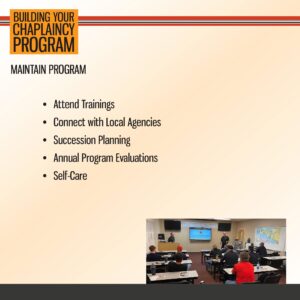
It is vital to maintain your chaplaincy program. You can do this by attending national, state, and local trainings, such as those provided by the International Conference of Police Chaplains, the Federation of Fire Chaplains, the Florida Firefighter Safety and Health Collaborative, and any other local programs you find in your area. The Florida Firefighter Safety and Health Collaborative is working, not only at the State level, but also at the local level, to support existing programs, share policies and procedures and help agencies start their program. These organizations provide training and the opportunity to network with other chaplains, which can aid in your growth and encourage best practices. As you develop and evaluate your program, try to forecast your succession planning as well. Sustaining a program after you have put the time and effort into building it will ensure that your work will help others for years to come. It is also suggested that you evaluate your program often. This could be done through member satisfaction surveys sent to the department, gathering member data, service utilization rates and other creative evaluation strategies. Finally, it is important to remember that while you care for those affected by tragedy and trauma, you must also take care of yourself. Establishing boundaries, developing strong support networks, and utilizing healthy coping mechanisms are all critical to maintaining your mental and physical health. It’s been said, “Caring for others is noble; caring for your self is required.”
Resources
Thank you for reviewing this training module. Please see the Chaplaincy Task Book attached to this section.