Critical Incident – Tim Nazzaro
Transcript
Hi, my name is Tim Nazzaro. I′m a Sergeant with the Orange County Sheriff′s Office in Orange County Florida .When we think about the first responder community, we often think first of the difficult and trying scenes they respond to throughout their careers. These are often referred to as critical incidents or potentially traumatic events. These events have the ability to shock the first responder′s conscious and are often the reason that first responder peer support teams will be deployed. In this module, we will discuss critical incident outreach, or potentially traumatic event outreach, and provide you with guidance for you and your team when performing this type of support for your members.
Other Modules
Critical Incident – Course Chapters
1. Introduction
Audio
Transcript
Critical Incident Outreach
Critical Incident Outreach Module. In this module, we will discuss Outreach practices following critical incidents. Outreach can be a valuable tool following a traumatic event. How a department approaches the follow-up to critical incidents, otherwise known as Potentially Traumatic Events, can have a significant impact on those involved. However, it must be stressed that if there has been no foundation laid, through education, peer outreach or competent clinician selection, you may find that responding to post-critical incidents can be extremely challenging and may not be helpful without these other components in place. Understanding best practices about how to respond following a critical incident has changed over the years and needs to be updated throughout the first responder community. Current best practices place a heavy focus on the education and resilience of your members, along with an emphasis on the Peer Support model of prevention and follow-up. If done correctly, this component will serve as another piece of the BHAP puzzle, setting the groundwork for follow-up from your peer support team.

Throughout this module, we will go through each objective step by step to provide you with a better understanding of how they relate to the BHAP initiative. We will include an overview of critical incident outreach, describe potentially traumatic events, discuss the importance of critical incident outreach, describe how to select a team to conduct outreach, discuss follow-up that should be included as a part of the process, as well as common roadblocks encountered, current best practices, and additional resources that may be helpful to you and your department.
You may notice as you watch this module that there is no focus on “debriefing.” This is important since debriefings conducted in the past have had mixed reviews from both first responders anecdotally and in outcome data. Some types of debriefings have been shown to be at best, not helpful, and at worst harmful. Rather than dissect the older approach, we will discuss the current best practices within this critical incident outreach module. We purposefully removed the debriefing language from this module to reduce confusion. Although many departments still call these debriefings, it is crucial that the content of the outreach is done in a manner consistent with best practices provided here. This helps reduce the potential negative impacts of techniques that previously were thought to be helpful.
Critical Incident or Potentially Traumatic Events
What is a Critical Incident or Potentially Traumatic Event (PTE), and what does an outreach look like? A critical incident is defined differently in reference materials. According to OSHA, a critical incident is having to witness or experience tragedy, death, serious injuries, and threatening situations. This is something that First Responders may see on a day-to-day basis. Florida Statutes also describes qualifying critical incidents for the purposes of workers’ compensation benefits. See Florida Statutes chapter 112.1815 for the most up to date definitions.
Importance of Critical Incident Outreach
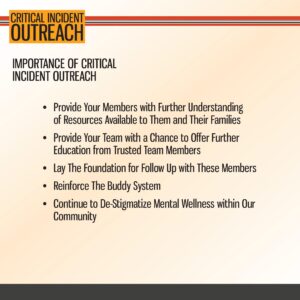
Critical Incident Outreach, when used in the context of the whole BHAP framework, can serve as an essential function of your BHAP. Previous models of critical incident outreach included mandating everyone potentially impacted by the incident to speak and discuss their thoughts and feelings on the incident. Much has changed in this area, and we now know this is not the recommended or best approach. Instead, we want to ensure anyone potentially impacted is provided with the resources they need and the opportunity to speak with a peer support team member or clinician.
Often after a critical incident, there is a lot of stress for those impacted and within the agency. Critical incident outreach has several important goals that build off other components of the BHAP system. First, part of the outreach should provide psychoeducation on what can happen following a critical incident. For example, some individuals may know they are struggling and need help immediately. For others, there may be a delay of days, weeks, months, or more. Some individuals may be fine, which is normal too. Providing background education on responses can help normalize how people are feeling.
it is important to remove barriers to help and resources. Post critical incidents or PTEs, it can be important to remind your members what resources the department has in place if they notice some of the signs and symptoms of stress from the incident. Including resources for both the team member and the family can be key at these events. Third, having the peer support team present this with a trusted clinician can be beneficial. This allows the impacted team members also to know what peer support can do, who they are, and remind them of the above resources. The added benefit of having a clinician with the peer support team allows the team members to see that there are clinicians who can support them through this. Although many will start with peer support, having the clinician available and as a known quantity can help reduce barriers.
These outreaches also provide further reinforcement of the “buddy system“. Knowing that despite all of your best efforts to provide an effective system for educational and peer support provided resources, we know that the most valuable resources your members will have are each other. Thus we advocate for a buddy system. This simple message reinforces the idea of looking out for each other on a more personal level. This system is set up with the idea that your members will see the changes in their co-workers before it becomes a crisis. This vigilance, in conjunction with your members knowing and understanding the resources available, will provide the best chance for success.
Small group outreach may be done in several ways, including visits to stations, meetups outside of work buildings, or whatever is best received by the team. Small group outreach may also help to further de-stigmatize the notion of mental wellness within our community. They may serve as an opportunity for our members to connect about issues they may have faced and how they have overcome them. This is often a by-product of these small group settings. We must clarify that testimonials that may be shared must be done in a way that does not expose your members to additional vicarious traumas. That means discussion of the details of the trauma should be limited. Peer support and clinicians should be trained and ready to manage this as it comes up in these discussions. Although talking through parts of the incident can be helpful for some, a better route is to focus on the resiliency of the affected individuals and the resources that are available to them.
2. Outreach
Audio
Transcript
Team Selection
It is suggested that the members of your Peer Support Team are the same members that perform your critical incident outreach. The exception to this would be that the Peer Team Members were involved in the incident themselves. This will afford you consistency throughout the entire process. This will also enable you to employ one recruitment tool, effectively reducing any confusion amongst your members. It is recommended that your department be provided the opportunity to select these members. For more detail and suggestions on that process, please reference the Peer Support Team Task book for member selection. You must also reassess your team members to ensure they continue to be effective through trust, empathy, and sufficient training. Nothing will erode your team faster than team members that do not have the trust and support of your membership. A constant vigilance, coupled with a transparent process for remediation and removal, will ensure that your team will continue to provide the most effective outcomes.

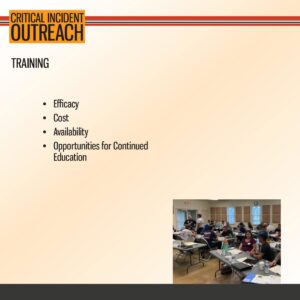
When making plans to train your team, the first thing you must identify is the efficacy of the training. There are many trainings available; some have proven to be more effective in the long term than others. Here are some things to consider when looking into training your team. Have other teams used this training, and did they find the material and delivery effective? Do they provide sufficient guidance tools to support your team during difficult conversations? Is this training affordable? It is essential to investigate trainings even if others have used them in the past. Trainings should be updated, and as new information about how to best manage critical incident outreach becomes available, our strategies should change to match best practices.
Following Up
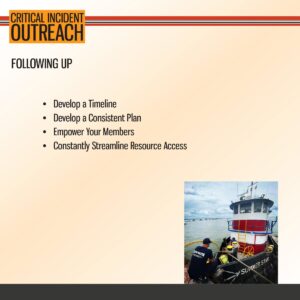
The key to effective critical incident outreaches is avoiding the “one and done” approach. It cannot be overstated that the BHAP model must be proactive and provide a way to monitor and mitigate the impact of ongoing exposure to potentially traumatic events as a first responder. Creating a system for follow up is a crucial part of this component. So what does an effective timeline look like? This is not an easy answer because it will differ for everyone. Since you may see the effects of these traumatic incidents weeks, months, and even years after the event occurred, it is recommended that you set up a check-in schedule at the one-month, three-month, six-month, and one-year mark. This type of follow-up is time intensive and may be impractical for every incident. In this way, the best approach is setting up the buddy system and empowering the company officer to notice the warning signs that a member is experiencing stress from an incident or multiple incidents. This can be done formally, but the best results commonly occur when the company officer genuinely cares for their members and approaches these situations with empathy and compassion. Typically, from a peer support approach, the follow-up will be an opportunity to reconnect with your members to shore up the education, resources, and awareness addressed following the incident. This follow-up will also offer an opportunity to ensure that all the resources continue to be streamlined for the best possible access to your members. Getting feedback from the members using such resources is crucial in this regard. Follow-up also provides an excellent time to gather input, find out what resiliency tools are being implemented, and if your peer support team is still being utilized effectively in the eyes of the members.
It must also be said that, more often than not, follow-up may occur in a one-on-one setting. This affords an added level of comfort between the peer and the peer supporter away from the group setting. Ensuring that your members know and have the ability to reach out in this setting is vital to ensuring that they receive the tools and support they need.
3. Challenges and Best Practices
Audio
Transcript
Roadblocks
As a first responder, organizations seek to provide critical incident outreach for their members, they may encounter a number of roadblocks that could hinder the success of these programs.
These roadblocks may include:
1. A “one and done” perception may occur when first responders perceive outreach programs to be a one-time occurrence, with no follow-up or ongoing support. For instance, if an agency only offers a single debriefing session after a critical incident, first responders may feel that their needs have not been fully addressed and may not seek additional support.
2. Inadequate planning can manifest when agencies fail to consider the unique needs of their members and provide appropriate support. This could happen if the agency doesn’t have a clear plan in place for responding to critical incidents, which could delay their ability to provide timely support.
3. Inappropriate timing may occur when agencies try to reach out to first responders when they are not prepared to receive support or are too overwhelmed to engage. For instance, if an agency reaches out to first responders immediately after a traumatic event, they may not be emotionally ready to engage in a supportive dialogue.
4. Insufficient personnel may happen when agencies lack enough trained professionals to provide support to their members.
5. Mandatory participation may make first responders feel pressured or uncomfortable, and they may not fully engage in the support offered. For instance, if an agency mandates that all first responders attend a critical incident debriefing, some may feel that they are being forced to participate and may not be fully receptive to the support offered.
6. A lack of support from administration may occur when an agency fails to prioritize or allocate sufficient resources to support critical incident outreaches.
7. First responders may feel that the outreach program is merely a box-ticking exercise if they do not feel heard or supported during the outreach.
By recognizing and addressing these roadblocks, first responder organizations can better support their members and help them cope with the aftermath of critical incidents. It is important for agencies to assess and identify what their specific roadblocks may be, in order to appropriately address them and better serve their members.

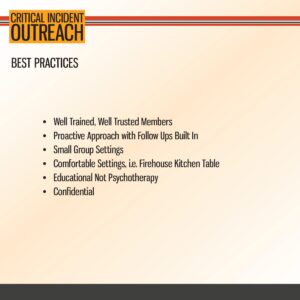
Critical incidents are a large part of first responders jobs. Understanding that the navigation of critical incidents is vitally important to the overall and sustained health of your organization. Having well-trained and trusted members is the cornerstone of your team. Ensuring that your team has and maintains these qualities must be your top priority. Solicitation and selection of your peer team members can be found in this Toolkit’s peer support team section.
As you are building out this team, it is imperative that you use a proactive approach with a follow-up system built in. This will avoid the one-and-done scenario that was mentioned earlier.
Keep the outreach small and the unit cohesive. This will typically increase the comfort level among the members. It may also decrease the potential to have conflicting personalities from different areas of your organization encountering issues, especially when vulnerability and high-stress levels may be present.
Keep the setting comfortable. Use a convenient and safe space for the members. It is important to not only think about the physical space being comfortable but also to keep the outreach comfortable as a whole. These outreaches being non-invasive will lead to greater success and reception amongst the crews. Remember, these outreaches tend to be inherently uncomfortable. Using any means possible to increase that comfortability is critical.
Remember, the goal of critical incident outreach is to provide your members with education, not psychotherapy. This outreach must maintain confidentiality. All these components are woven together: trusted members, follow-up, cohesion, comfortable settings, and the understanding that anything shared will be confidential will be crucial to the success of critical incident outreach.
Resources
Thank you for viewing this module on Critical Incident Outreach. Please see the Task Book for additional resources on this topic.