
K9 Support – Jackie Spence
Transcript
Hi, my name is Jackie Spence. I am a retired Division Chief of Health and Safety for Osceola Country Fire Rescue, and this is my K9 partner, Merlyn. Many theories and mechanisms have been proposed to explain the unique healing benefits of K9 in humans, especially for those looking to improve mental wellness. The roles of therapy dogs is increasing from nursing homes and schools to airports and courthouses. Health benefits such as lower blood pressure, pulse, an immediate physiological calming response from chemical release are becoming more well known, and these benefits are being incorporated into first responder agencies to help mitigate the effects of occupational stress. There are many factors to consider when looking into building your own K9 program. K9 and handler selection, training, certification and policies are just a few. This module will present you with some basic considerations that will help you establish a K9 program that suits your organization’s needs and becomes an effective tool in your mental wellness toolbox.
K9 Support – Course Chapters
1. Overview and Benefits
Audio
Transcript
Building Your K9 Program
Building your K9 Program. Building a K9 support program for your agency requires careful planning and consideration. This module will provide step-by-step guidance to help establish a successful program.

Throughout this module, we will focus on several key objectives to help you create a successful program. You will learn about the impact and benefits of having a K9 program for your department, how to select the appropriate program for your team, and identify necessary resources. Additionally, we will discuss how to select and train the K9 team, obtain necessary certifications, gain buy-in from your administration, address administrative concerns, and develop effective policies and standard operating procedures (SOPs). By the end of this module, you will have the knowledge and tools needed to establish and maintain a K9 support program for your first responders.

Benefits
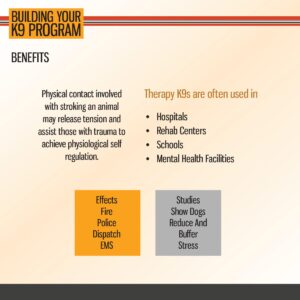
There have been multiple research studies that show that first responders are more likely to die by suicide than in the line of duty. This includes Fire, Police, Dispatch, and First Responders. The benefit to having a K9 Program is to assist in the management and mitigation of occupational stress, PTSD, suicide ideation and other stress related disorders that could possibly lead to death.
K9s reduce and buffer physiological and endocrine stress responses. There is a need for feelings of safety and security for those who have experienced trauma, and in many cases K9s can offer this form of attachment in unique ways. Physical contact involved with stroking an animal may release tension and assist those with trauma to achieve physiological self-regulation.
Animal assisted therapy has been acknowledged to be an effective tool in environments where stress or isolation is a concern. Canines are often used in hospitals, mental health institutes and rehabilitation centers where their presence diminishes feelings of fear, distrust, rage, aggression and help enrich interpersonal relationships.
Program Selection
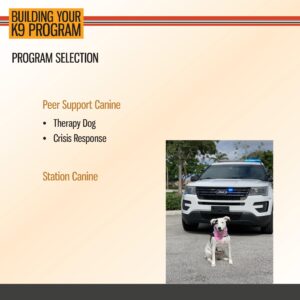
Two common ideas for using K9s in mental wellness programs are Peer Support K9s and Station Dogs. If there is no peer support team, a station canine can provide many documented benefits of therapy dogs. If a station member would like to become a handler with the station canine, they can complete the therapy dog certification. That member can bring the dog to visit all the stations so more people in the organization can enjoy the magic of the dog.
Peer Support K9
When utilized correctly in a one-on-one group peer response setting, the interaction of a well-trained K9 Peer Response tandem can be beneficial and cathartic. The handler should be a trained peer with additional extensive training with his or her K9 partner in Critical Incident Peer Response.
Peer Support K9
If you already have a Peer Support team, a K9 component can be a welcomed addition. Once properly trained and certified, the handler may gain department approval to take the K9 to work during their shift. In this case, the dog can now serve all in the stations and respond to peer callouts. Station etiquette training involves safely acclimating the canine to the station, avoiding hazards, and training the crew to interact properly with the dog is recommended.
2. Implementation and Training
Audio
Transcript
Peer Support K9
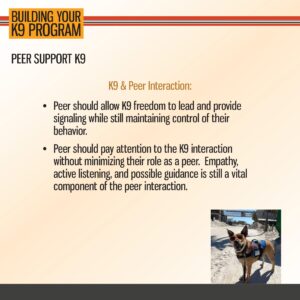
Ideally, the handler should be proficient in their peer skills and have experience as a peer before bringing the dog into the equation. Also, an experienced therapy dog handler would be a great start to learning best practices for using the canine in peer support roles. The expected benefits from the canine are non-judgmental, social support, alerting, and creating a safe space to share experiences.
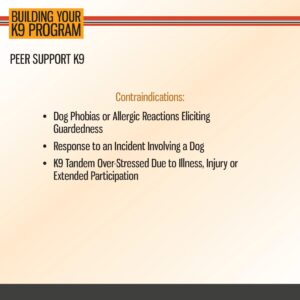
While K9s can be highly beneficial in mental wellness programs for first responders, there are some contraindications to consider. Individuals with dog phobias or allergies may feel guarded around K9s and may not benefit from their presence. Additionally, if a person has experienced a traumatic incident involving a dog, the presence of a K9 may trigger negative emotions. It is also essential to be mindful of the K9’s well-being; if a K9 tandem is over-stressed due to illness, injury, or extended participation, their presence may not be helpful. It is crucial to assess each situation carefully and ensure that using K9s is appropriate and safe for everyone involved.
Therapy Dog
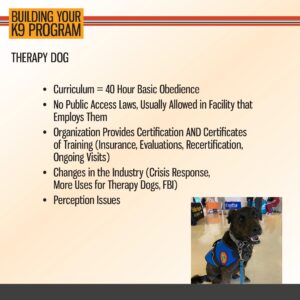
The curriculum for Therapy Dogs is mostly basic obedience and socialization. They do not have public access laws per the ADA like service dogs do but are generally allowed in the organizations that employ them. There are at least five organizations nationwide that provide national registered certification. Insurance is provided in this case, and ongoing visits, training, re-certification, and evaluation are required. However, many more therapy dog organizations provide a certificate of training. They do not provide insurance and have no ongoing requirements for further training, visits, evaluations, or re-certification. As the popularity of therapy dogs continues to grow, many organizations are attempting to provide Crisis Response to their list of certifications. However, due diligence is required, as many of these organizations are NOT following the national standards and are not providing the hours of training and evaluation needed to produce a Crisis Response K9 that can be considered deployable. Another obstacle can be the perception as therapy dogs are just pets. This is not true, but this makes sense due to the lack of curriculum and ongoing training requirements. As the role of therapy dogs continues to grow and become accepted, hopefully, this will change. This is also why behavior assessment and training should be paramount to any first responder organization.
Crisis Response
Compared to the therapy dog curriculum, the Animal Assisted Crisis Response (AACR) curriculum is much more extensive. The canines are expected to be resilient to a broader range of human emotions and environments, such as emergency scenes. When we think of therapy dogs, we think of controlled environments such as schools, nursing homes, etc. Crisis Response canines are expected to be able to navigate uncontrolled emergency scenes and work with people experiencing the worst tragedy of their life. The curriculum should include handling skills (advanced), public access training, reading canine body language and communication, deployment, and best practices for using canines in peer support roles. The training includes practicum scenarios, evaluations in each section, and, finally, certification. The insurance provided is normally 2 million dollars, and the certification is good for three years. There are also other required classes to support and finish the certification process. While the therapy dog level is acceptable for a station dog, Crisis Response is the standard for deployment and using canines in peer support.

Station Dog
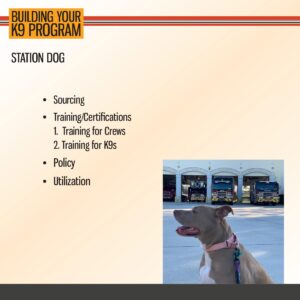
Another idea to get the healing benefits of dogs is a station K9. A dog can be trained in basic obedience, properly acclimated to live full-time in the station and become part of the station family.
Consider contacting local shelters and rescues when sourcing dogs for your K9 program. Many of these organizations have a surplus of dogs and may be willing to donate them to your program, which can help keep costs down. However, conducting a temperament or behavior assessment for any dog under consideration is essential to ensure they have the appropriate temperament for the work and environment. Some rescues and shelters have trained personnel who can perform these assessments and work with your department to ensure a good fit for the dog and the program.
For training, it is suggested to provide basic obedience and acclimation. Since basic obedience and socialization is the standard acceptable training for therapy dog certification, the dog can be trained as a therapy dog. There are organizations offering certificates of training and those that offer certifications. Station personnel interested in becoming handlers can get certified with the dog and conduct visits to stations, schools, nursing homes, or courtrooms as a form of service to the community.
Once decisions are made regarding what program you are creating, a written policy is suggested. This will help ensure consistency in training, care, animal advocacy, and safety. There are many ways responsibilities can be shared. For example, one suggestion for care and feeding is to have two volunteers per shift, one primary and one backup person who agree to be caretakers. Feeding times, play/exercise time, and health care can all be rotated. The two caretakers per shift would be primarily responsible, and the expectation is that others would want to help as the bond with the dog grows among crew members. Alternatively, a care schedule can be set for the off-duty members if the crews live nearby.
There are multiple ways to utilize this fantastic resource. For instance, if the organization has multiple offices or stations, a rotation of visits is a suggestion. This way, more people in the department benefit from the dog. If you decide to certify your member with the dog, bi-monthly rotation visits may be required. This is an excellent opportunity to serve your community while you train.
Team Selection
A handler should be dedicated to helping their peers while keeping the needs and safety of the animal a priority. The first responsibility of the K9 handler is their canine’s health, welfare, and safety. If this gets compromised, so does the mission, as the canine relies on its handler for leadership and guidance. The handler should be appropriately trained in peer support and canine handling as well as familiar with reading the signals the canine gives them. They should be expected to comply with a standard of practice, as an eager handler may overlook the canine’s needs to ensure peer satisfaction. An understanding is needed that animal advocacy should be included in everything from basic training, policy, transportation, and mission. The ideal handler should be calm in their interaction as everything travels down the leash, which may affect the canine’s performance. Also, stability is essential for conveying a safe, trustworthy presence.
Additionally, choosing the right canine is essential. The canine should be able to tolerate the work and enjoy it. Proper veterinary care and training are also essential. Furthermore, a solid relationship between the handler and the canine is based on love and trust. The canine should be trainable and thrive with training. A dog can be trained to go to someone, but ideally, the dog shouldn’t always need to be directed to do so. The animal should be social and feel safe around strangers. Canines that are healthy, reliable, and controllable are usually well-suited for the work of therapy dogs. A calm demeanor is appreciated and expected. Whether the animal is from a shelter or breeder having a behavior assessment, health evaluation, and positive reinforcement training are paramount for success. A dog with the right temperament for the work is more important than selecting a specific breed. No matter which breed is chosen, a behavior assessment should be done to ensure success.

Training & Certifications
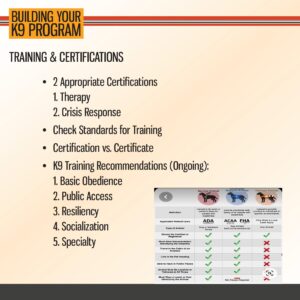
There are two suggested certifications currently appropriate for Peer Support: Therapy Dog, and Crisis Response K9. Both have standards applied to them. For example, The Animal Assisted Intervention International (AAII) Standards of Practice apply to therapy dogs. There is also the National Standards for Animal Assisted Crisis Response (AACR) for the Crisis Response Canines. Some ongoing training suggestions at the Crisis Response Level include Basic Obedience, Public Access, Resiliency, Socialization, and specialty training. Some trainings will overlap, but the more training you do, the more bonded and resilient your K9 team will be. The preferred training style is positive reinforcement.
Something to pay attention to is the difference between a certification and a certificate of training. Not all organizations issue certifications. When looking into certifications, be aware that some offer insurance policies that get renewed upon recertification as well as providing a registry.
Knowing the difference in the levels and types of dogs is essential and so is using the correct verbiage for the kind of canine your program will use. Many people use general umbrella terms like “comfort dog” or “support dog” without understanding the difference. A support dog is considered an ESA–an emotional support animal. ESAs and service dogs are trained to support one person, the handler. A doctor’s note is required for both and ADA laws apply only to service dogs. ESA’s are generally untrained, well-behaved smaller dogs and have permission, when applied for, in terms of housing and commercial flights. Therapy dogs and Crisis Response K9s are dogs trained to help other people, not just their handler. They have different training and certification requirements. Comfort dog is an umbrella term typically used to describe any dog that comforts someone. It is a vague term and has no training or certification requirements.
3. Administration and Policies
Audio
Transcript
Buy In
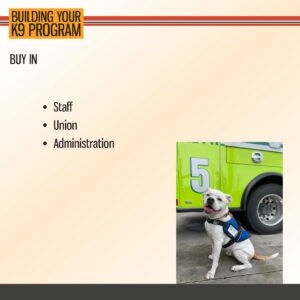
Having buy-in and support from key stakeholders will ensure the success of a K9 mental wellness program. If applicable, stakeholders may include upper and middle management, rank-and-file employees, union or local leadership, and government or political entities. One way to gain support is to use the K9 team for public events, such as demos in schools, nursing homes and events with the public education department. This serves the community and provides training opportunities for the handler and K9. If the department has a peer support team, gaining permission to use them during outreaches can be helpful when adequately trained. Additionally, having an SOP/SOG in place can ensure that all organization members know the program and how to utilize it effectively.
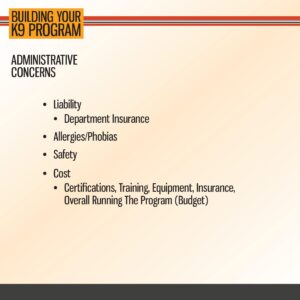
Organizations that want to establish a K-9 program often have concerns about the cost, liability, and how to handle people who are allergic or afraid of dogs. Regarding cost, the program’s specifics will determine the expenses. Factors to consider include whether the Peer Support Team is volunteer or paid, canine source, and training. Finding a rescue or shelter that can donate a dog is a good way to save costs. Private trainers, dog stores, or handler certification to become a trainer are other cost-saving options.
Liability is always a concern in any program. Training, policy, and certification that comes with insurance can help mitigate the risks. While some department canine teams are covered under their departments’ umbrella insurance, others are not. So, it’s important to research different organizations that provide insurance to ensure adequate coverage. Some Therapy Dog Certifications will provide coverage for the dog’s work and off-duty time. It is wise to explore how to get the dog covered under the department’s insurance in case of injuries.
When it comes to allergies or phobias, the aim of therapy dog programs is to reduce, respond to, or prevent occupational stress. Working in an environment with a known allergy can produce stress, so it is best to ensure all regular employees at that location are free of dog allergies if you plan to implement a station dog. If someone working overtime is allergic, the dog can be separated from that person as per ADA service dog requirements. If separation is not possible, another invested person should be able to remove the dog while the person with allergies is at work. For those with dog phobias, exposure to the dog is not helpful, so it is not recommended to place a dog at a location where someone is afraid of dogs.
Policies and SOPS
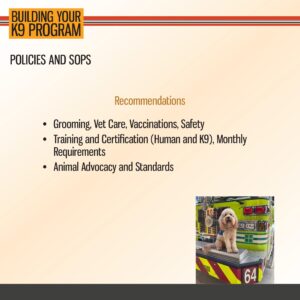
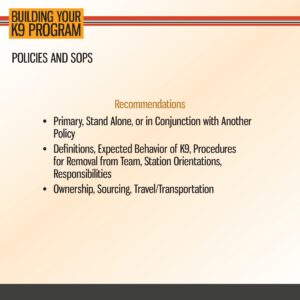
When implementing a K9 program, it is essential to have a clear policy in place. This includes grooming, veterinary care, vaccinations, and safety measures to ensure the K9’s well-being. The handler and K9 should receive training and certification to meet animal advocacy and standard requirements. Monthly requirements such as training and evaluations should also be considered to maintain the K9’s skills and abilities.
Policies and SOPS
To ensure a successful K9 program, it is recommended to have policies in place that define expected behavior, procedures for removal from the team, and station orientations. The policy should also cover ownership, sourcing, and transportation of the K9. This policy can be stand-alone or integrated with other existing policies. If your organization already has a BHAP policy, aligning the K9 policy with it or integrating it into a single policy is recommended.
4. Step by Step Guide and Resources
Audio
Transcript
RESOURCES
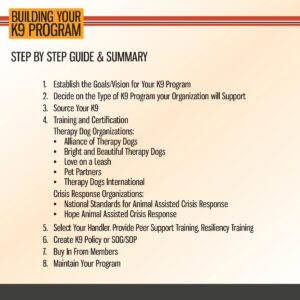
Starting a K9 support program for first responders can be broken down into several steps. First, establish the program’s goals and vision. Next, decide which type of program your organization will support and consider resources such as local shelters, rescues, and therapy dog organizations. After that, choose the appropriate level of certification for the program and select a handler who has undergone peer support and resiliency training. Look into other local organizations’ K9 programs and policies for guidance. To gain support for the program, educate administrators and union officials on the impact of mental health issues and the benefits of the K9 program. Ongoing training for the handler, canine, and station is essential. Serving the community through demos, visits to schools, nursing homes, and community events can help raise awareness. For more detailed guidance, refer to the task book section of the module.
Other Considerations
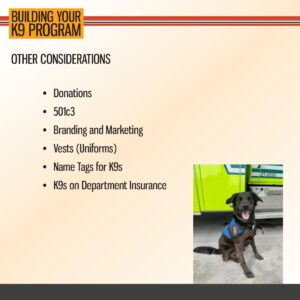
When setting up your K9 support program, there are several things to consider for success. First, you may consider establishing a 5013c so that you can receive donations for expenses not covered by the organization. It’s also important to focus on branding and marketing efforts to raise awareness of your program within your organization and the local community. Additionally, providing vests and department IDs for your K9s can show support for the program and instill a sense of accomplishment and pride in those who have put in the training hours with their canine partner.
Resources
Thank you for reviewing this module. Please see the below resources for additional information on the included topics.