Peer Support – Brittney Smith
Transcript
Hi, I am Brittney Smith. I am a firefighter paramedic and peer sport coordinator with Maitland Fire Rescue. Peer support for first responders is the foundation of a resilient organization. Peer supporters come from similar backgrounds and bring shared life experiences to difficult conversations. With proper training and guidance, these peers can offer the members of your agency the ability to come forward in a safe, non-judgmental environment to seek guidance and help from a trusted department member. This module will guide you on who makes a good peer, how to select your program, and how to maintain your program once it is up and running.
Other Modules
Peer Support – Course Chapters
1. Building a Peer Support Team
Audio
Transcript
Building a Peer Support Team
Building a Peer Support Team

Objectives: By the end of this training, you will have the knowledge to develop and maintain a peer support team, including the ability to define peer support, recognize the critical development needs of the peer support team, create strategies for member engagement, and learn practices for sustainability and evaluation. At the end of the training is a resource page with the additional materials referenced throughout the training. There is a task book attached to the resource section of this module. This will act as a guide in the development and implementation of your peer support team.
What is Peer Support?
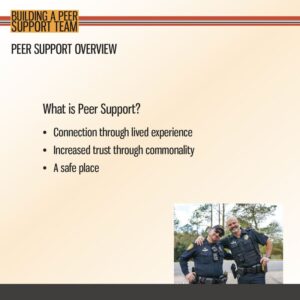
WHAT IS PEER SUPPORT: Peer support is a connection with others through shared lived experiences. Peer supporters use commonality and empathy to build trust and offer hope. Peer supporters can navigate friends, coworkers, and loved ones through difficult times using empathetic, non‑judgmental listening. They provide a safe place for peers to reach out and ask for help and empower team members to make decisions when they have previously felt powerless or out of control.
Quality of a Peer Supporter
QUALITIES OF A PEER SUPPORTER: A successful peer supporter can communicate effectively, engage with a warm, non‑judgmental demeanor and provide empathy. Being open allows them to be accessible and encourages mutual, honest dialogue. Honesty is essential since peer supporters sometimes need to convey hard‑to‑hear feedback to their peers. This direct feedback can only be accomplished after the peer supporter and the member has established mutual trust.
Peer supporters must use critical thinking to provide positive resources and aid with possible solutions. Critical thinking skills are necessary to help the peer supporter detect an impending crisis or critical event before a crisis is reached. Critical thinking can help determine the member’s actual needs by listening to understand what may not be communicated verbally or directly. Peer supporters know the right time to share their personal experiences. These relationships are not just about shared difficulties. The peer supporter guides the conversation in a positive, healthy direction while ensuring the member feels heard and validated.
Peer supporters have a collaborative mindset and work together with members to solve problems. Teamwork applies to working directly with first responders, as well as with the rest of the peer support team. A successful peer supporter knows that many people are needed to maintain the program’s success. They are reliable; they do what they say they will do in an effective manner while maintaining the confidentiality of others. They are guided by the ethics of the role, not the prestige that may come from it. Peer Supporters must make hard choices that do not always have a clear answer. It is vitally important that the peer supporter has a reliable moral compass to ensure the safety and security of their peers.
Florida Legislation
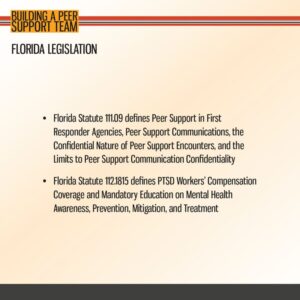
FLORIDA LEGISLATION: The State of Florida recognizes the value of the first responder Peer Support Model. Legislation passed in 2022 codifies the important role of peer supporters within agencies and provides guidance on maintaining an ethical and efficient program. Florida Statute 111.09 defines the expectations of a peer support program, and outlines mandates for communications and confidentiality, including the limitations of confidentiality.
Peer support models can act in tandem with the requirements set forth in Florida Statute 112.1815.
F.S. 112.1815 includes the standards for determining eligibility of employment‑related post‑traumatic stress disorder under workers’ compensation insurance for first responders. The law allows first responders that meet certain conditions to access indemnity and medical benefits for PTSD without an accompanying physical injury. Subsection (6) of this statute directs that “An employing agency of a first responder, including volunteer first responders, must provide educational training related to mental health awareness, prevention, mitigation, and treatment.” Please see the resource page for links to Florida’s most recent legislation.
Resource Links
2. Peer Support Team Development
Audio
Transcript
Identifying Need and Impact on the Agency
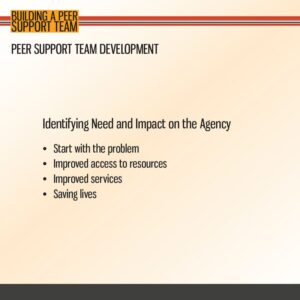
IDENTIFYING NEED AND IMPACT ON THE AGENCY: To identify the need, you must first start with the problem. First responders have a heightened risk for post‑traumatic stress and related trauma disorders, suicidal ideations, alcohol and substance misuse, anxiety, and depression due to repeated exposure to crisis and trauma. Couple this work/life imbalance, longer shift hours, sleep deprivation, moral injury, and high occupational stress including administrative betrayals and workplace incivility increase the risk for mental health problems. Therefore, there is a need to have access to ample resources. Peer support can act as a bridge to your Agency’s long‑standing available resources, which can increase the use of those resources, reduce worker compensation claims and boost the morale of everyone in your Agency. In short, the impact is saving lives, of the team and the public, strengthening agency response, and improving the quality of services.
Identifying the Need and its Impact on the Agency are discussed in greater detail in the Building your BHAP module that can be found on the resource page. If your agency does not have any available resources, developing a peer support team can serve as a first step in beginning to identify, vet, and assemble these resources.
Description
- Identifying Need and Impact on the Agency
- Start with the problem
- Improved access to resources
- Improved services
- Saving lives
As with any new program, there will be related costs. These costs may vary from agency to agency, so it is vital to consider your program’s needs. The examples here will help you consider some of the expenses that you may encounter. The Peer Support Task Book will also help you break down the costs associated with your program. We encourage you to develop your own lists of costs associated with your program and, as you do, list the benefits that may come with those costs. We have provided a few examples; however, the more expenses you can think of, the more prepared you will be.
Training Expenses: Training will likely be your peer support model’s most significant financial investment. Ultimately, the more expertly trained the team, the greater the benefit to the program. They will know expectations, understand mental wellness, and be able to navigate sometimes difficult situations, such as confidentiality issues, suicidal members, and high‑stress situations. You should consider who will provide training to the team, how often training will occur, and how teams are compensated for attending training. If training is developed internally, you may need to consider if compensation is warranted for training development and delivery. It can also be beneficial to pool resources with neighboring agencies to reduce training costs and ensure that your region is trained to the same standards.
Program management/operational needs: Another cost consideration is who will manage the program. Access to funding may help determine if the team is volunteer or paid. Peer support services have historically been voluntary, which is considered best practice for multiple reasons. However, some organizations will pay a small stipend to the peer team members as well as the lead. Whenever possible, a paid lead can increase the accessibility and accountability of the program. Additional consideration is needed depending on the roles team members already play within the agency. If members are pulled from their assigned duties to perform peer support functions, associated operational costs may be needed to fill their primary positions. In addition to time, you may also have to consider tertiary costs, such as travel expenses, and if there are budget options to address these costs.
Resourcing: Resource Development is necessary to keep members informed of the program. Costs may vary depending on what type of resources you adopt. Some examples of these resources include flyers, posters, and other informational items, such as magnets and coffee cups. In addition to these resources, you must also consider how they will be delivered and where they will be housed. This includes digital, print, and/or websites. Often departments have success with external websites that house their resources and provide a way to access those resources outside of work.
Incentives: Finally, Incentives are a way to get and keep people engaged in the program. Showing up to a location following a critical incident may be more well received if you provide food or beverages when you arrive. This often helps in breaking the ice with the members that your team is there to help. Items such as this may be provided at peer support team meetings as well. The best way to evaluate the initial costs of the team is to use the COST worksheet to help you identify costs and weigh the benefits as you get started. A short list of benefits is discussed next. More information on the worksheet is available on the resource page.
THE RESOURCE PAGE HAS COST/BENEFIT WORKSHEET
Description
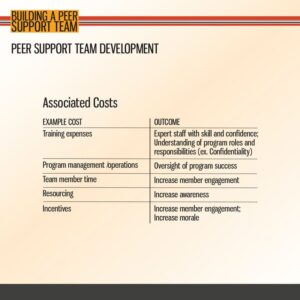
Associated Costs
| Example Cost: | Outcome: |
| Training expenses | Expert staff with skill and confidence; Understanding of program roles and responsibilities (ex. Confidentiality). |
| Program management /operations | Oversight of program success |
| Team member time | Increase member engagement |
| Resourcing | Increase awareness |
| Incentives | Increase member engagement; Increase morale |
Benefits of Peer Support
The benefits of peer support are resounding and discussed throughout this training, but it is important to highlight the ways that peer support can shape and support your agency and members.
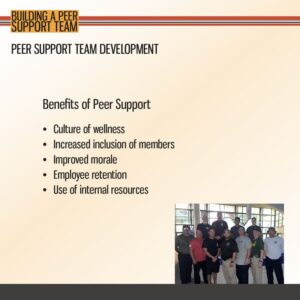
One of the most significant benefits of peer support is the ability to offer a cost‑effective approach to promoting and sustaining a culture of wellness. This culture of wellness is accomplished by presenting this initiative in a manner that your members can understand and is provided by people they trust. Peer support has the potential to create a sense of belonging among members who feel isolated, alone, or struggling to find authentic validation and support. It is common for this to be accomplished more effectively in a peer setting than in a professional environment. Peer support can promote inclusion for employees with mental health issues, decrease occupational stress, and improve morale by demonstrating that the employer cares for their members’ well-being. In turn, this can increase employee retention, reduce worker’s compensation claims and promote the use of agency‑provided mental wellness resources such as Employee Assistance Programs (EAPs). Often, these initiatives offer your members the ability to help shape the resources you provide, give them a say in their path to wellness, and ultimately empower them throughout their careers.
It must be restated; peer support has a strong body of science supporting the concept. It is evidence based and has been proven to be one of the most useful tools you can provide your organization to maintain your healthy workforce. Please see a list of citations on the resource page of this module for more information.
Description
Benefits of Peer Support
- Culture of wellness
- Increased inclusion of members
- Improved morale
- Employee retention
- Use of internal resources
Buy In
Crucial to this is fostering an environment of collaboration. Ensure that your agency’s human resource department is included in the process. HR teams know the most about agency policies, internal resources, and employment law. They can provide essential information throughout the development of your program and when the program’s needs change. Involving HR in conferences and training to receive firsthand information on the structure and goals of the program allows a transparent way for them to garner and share feedback and direction.
Your Senior staff is likely to be the most involved in the day‑to‑day issues pertaining to peer support. Ensuring that they fully understand your program’s mission and expectations can help keep operations running smoothly. Ensure that they know the expectations and what is required to make this program a success.
Lastly, union leaders are necessary stakeholders in developing your peer support program. Local union leaders are likely to recognize the program’s importance and are familiar with available resources in your region and beyond. Soliciting their voice will permit them to take ownership in the program and can provide the members of your department another reason to trust this initiative.
Additional information on Buy In can be found in the Leadership section of the Toolkit.
Description
Buy In
- Agency Administrators
- Senior Staff
- Union Leaders
Development of SOP/SOGs
DEVELOPMENT OF SOP/SOGS: When creating the standard operating procedures for the peer support network, it is important to outline how the procedures fit into your agency’s overall BHAP system.
There are several specific items you may want to include in your SOP: A Mission Statement: A clear and concise mission statement will allow members to refer back to the guiding principles under which the team operates and create the starting point for how you build out your specific procedures.
Team Lead Criteria and Chain of Command: The chain of command is essential so that there is a clearly defined route for resolving issues and addressing needs that may arise.
Having written procedures provides transparency and smoother transitions from one team leader to the next. It dispels confusion by defining who the superior is and how the chain of command is followed. Consider also defining peer support team member criteria and where they fall in the chain of command in this section.
Confidentiality Agreements: Because of the nature of the peer supporter’s role, team obligations, legal obligations, as well as confidentiality and exceptions to confidentiality, must be clearly explained in the SOP. Knowing what remains confidential and what information the peer team members must disclose provides team members direction when an issue or crisis needs to be elevated. This can also help everyone involved with the BHAP understand confidentiality’s importance and legal expectations.
While transparency and uniformity are critical, you should also consider how you will update the policies as new information becomes available. Updating SOPs can be a complicated process, but there are ways you can simplify this process. For example, using language such as “the most up‑to‑date evidence-based model” instead of naming a specific model in your original SOP will create flexibility as the science around mental wellness changes.
Please see the taskbook for additional information on building the SOP.
Description
Development of SOP/SOGs
- How does the peer support SOP fit within the context of your BHAP SOP
- Allow for changes and growth within your team
- Things to consider:
-
- Mission Statement
-
- Team lead Criteria and Chain of Command
-
- Confidentiality agreements
Peer Support Manual
In addition to the SOP, developing a Peer Team Manual can serve as a guide to your team’s roles and responsibilities and allow for more specifications than what is in the formal SOP/SOG. The manual may also allow you to provide updates more easily and make changes as new materials begin to replace outdated ones. Examples of items that may fit best in a manual include:
Communication practices: The manual can define how communication within the team is conducted- if the team leader needs to communicate with the entire team promptly, establishing that process so everyone knows what to expect can increase efficiency. Some teams use external messaging apps to allow for consistent, reliable, fast messaging to go out to the team when needed in a timely manner.
Outreach: How outreaches are requested, planned, and conducted may typically fall under a shift lead or team leader’s responsibility. However, in their absence, knowing the process and procedure will prove invaluable to the team members tasked with that goal.
Tracking criteria: A tracking system will allow the team leader and others to see trends in mental wellness, team utilization, and any items that may need to be addressed. Educational tracking must also be managed to keep continuing education for the team updated and current. The second Alarm Project has a tracking tool that will allow anonymous tracking of your team’s contacts. Please see the resources section for additional information.
Dealing with crisis situations: The manual should include guidance on addressing crises that may arise in peer support, such as addressing suicidal or homicidal ideations. Resource materials for the peer team, including criteria on crisis centers, recommended inpatient facilities, and appropriate community resources, as well as defining who is “on call” in case of emergencies, should be included here.
Description
Peer Support Manual
- Roles and Responsibilities
- Communication Practices
- Outreach Efforts
- Tracking Criteria
- Dealing with Crisis Situations
Identifying the Team Lead
Identifying a team lead: The team leader plays a vital role in the peer support model and has a critical role in team management. The position requires flexibility and a willingness to be called during “off” hours. It is a big responsibility that can cause additional stress. It can be a strain and knowing that your team leader will not be putting themselves in danger, either physically or mentally, by taking on the vicarious traumas of others, is a significant consideration. Often the role is filled by someone already in trauma/stress recovery and is interested in providing leadership to the program. It can be very powerful to have the team lead model the program’s benefits as long as they utilize resources to maintain their own well-being. Recognizing this characteristic within potential team leads is critical to protect the individual, the team, the program, and the members.
A team leader must be a member in good standing. Someone with a lengthy disciplinary background will not gain the administration’s trust. Inversely, someone who is not a people’s advocate will not achieve the members’trust. The talent pool widens when agencies recognize that leaders may lead from any rank. Sometimes the most valuable skills are overlooked because of the position that person holds within the agency. The team lead role is an opportunity to empower individuals who demonstrate the necessary attributes and provide them with trust and autonomy regardless of their rank. An application process to be a team leader and one to be on the Peer Support team is a valuable tool. Using an application process further ensures that the most qualified members for the position are the ones chosen. Many of the qualities of a good team leader are the same qualities as the peer supporter; they must be honest, communicate openly, and work from a collaborative mindset. In addition, they must utilize several leadership skills, such as:
Decisiveness: The team leader must be able to take in information and make informed decisions. Sometimes these decisions are not easy. It is vital to have a strong leader with a solid moral compass willing to make these challenging decisions.
Innovation: The team leader must be creative in how they message information and be curious about the new information that will progress the team’s goals. There are constantly new ideas and new evidence to support first responders in the field of brain science; as a result, the lead must find innovative ways to steer the program with that science.
Responsibility: There is a lot of responsibility associated with this position. Willingness to take on responsibility and manage responsibility is a vital component of a good team leader.
Motivation: A good team leader can motivate their team and themselves. This demanding role may not always garner the credit that sometimes comes with a more transparent,higher‑profile position. Therefore, team leaders must be willing to do hard work with little to no credit and utilize internal motivation to support them.
Description
Identifying the Team Lead
- Belief in Mission
- Flexibility
- Recognition of personal needs/recovery
- Standing
- Communication
- Honesty
- Collaboration
- Decisive
- Innovative
- Responsible
- Motivation
Establishing the Peer Support Team
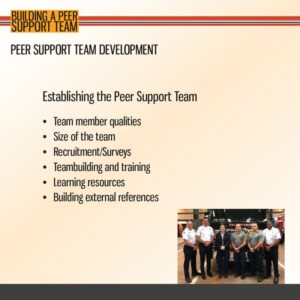
Establishing the peer support team: Once in place, the team lead can begin to structure the peer support team. Team members should emulate the qualities described initially in the Qualities of a Peer Supporter. Please return to that section for a review of those qualities.
When establishing the team, we suggest you do not limit your team size initially or at all, since team needs may fluctuate as the program grows. Over time, you may find a standard number of team members suitable for your department’s needs.
Determining how to recruit the team is a critical component for success. Utilizing a core group of individuals to engage in one ‑on ‑one outreach at stations or morning briefing locations, along with releasing a joint message from the administration and union, provides an excellent opportunity for strong interest and dialogue among rank ‑and ‑file members. An innovative practice quickly becoming the industry standard is allowing members to pick the team through a survey. Members are more likely to utilize peer support when they are invested and feel that they contributed to the team in some way. A survey is a primary way to ensure that team members are trusted by their peers. The survey can also inform what resources members are aware of and currently use, and it can allow for feedback on why specific resources are not utilized to their full potential. The survey does not need to be time ‑consuming; it can contain just a few questions on resources and three spots for members to fill in the names of potential team candidates. When you find the same names again and again, reach out to those members, inform them of the department’s view of them, and ask them to participate in the team. This method allows your members to buy in, builds automatic trust, and motivates the selected individuals to join the team.
Once the team is identified, team building can make the team more cohesive. Engaging in training and building publications can increase the team’s understanding of their purpose and increase pride in their involvement. Many training opportunities will initially benefit the team. However, training must also be ongoing and readily available to your peer team members. Both external and internal training should be utilized to ensure an understanding of national best practices and agency procedures and processes. Effective training should at a minimum include: active listening skills, how to start a conversation, how to have difficult conversations, how to develop resiliency tools to avoid burnout and vicarious trauma, working with people in crisis, and how to access resources.
When the team first comes together, learning your agency’s resources should be a priority. Effective peer team members also need to know about community resources to provide them to your members. Information about your agency’s and community resources should also be available to members and members’ families during off hours when it is more likely for a crisis to occur. Creating external access through weblinks enables updates as resources change and allows everyone to stay updated on resource availability. Many team agencies house these resources on an external website built by the BHAP or Peer Team. The page can then be referenced by a QR code sent to each member’s home for easy access.
Some items to consider providing in the external references include:
‑your peer team members and contact information
‑your agency resources, such as EAP and health insurance information
‑Local community resources, and
‑crisis hotline numbers
Description
Establishing the Peer Support Team
- Team member qualities
- Size of the team
- Recruitment/Surveys
- Teambuilding and training
- Learning resources
- Building external references
3. Sustaining your Team
Audio
Transcript
Member Engagement
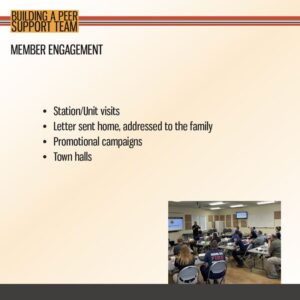
The members of your department are the front line in the healthy workforce initiative. They work with each other daily and have the highest likelihood of informing the peer support team of the unit’s needs. The same thing can also be said about your members’ families. Creating ways for members to talk about available resources openly and ensuring that they understand how the program works enhances the potential that they will remind each other of the resources available and utilize them for themselves. There are several ways to engage members in this process:
Station or unit visits allow your team to visit with members at consistent intervals, such as once a year. When members see the Peer Support team before a crisis even occurs, it fosters an environment of accessibility and allows members to ask questions, learn motives, and lay a foundation for receiving help before an injury. Having a proactive team encourages members to consider their mental wellness regularly and to utilize the skills they learned as preventive measures.
Promotional campaigns can also be used to garner interest in the program. This may include a letter campaign, magnets, coffee cups, or other materials that convey access to the resources, such as the QR code discussed previously.
A town hall meeting, in person or online, allows members and their families to ask questions and creates a more intimate way to deliver your message.
Encourage creativity with the engagement campaign. There are several unique ways to engage members; some may already build from the organization’s culture and others from the individuals who encourage excitement in the workplace.
No matter how you engage the membership, it is essential to recognize that your team cannot succeed without your members.
Description
- Station/Unit visits
- Letter sent home, addressed to the family
- Promotional campaigns
- Town halls
Ensure that your team leader has the resources necessary to maintain your team. One of these tools may include time. Typically, in these volunteer‑led initiatives, burnout can be a real factor, especially if the peer team members doing most of the work are not provided with the tools to complete their tasks. Time is often one of the tools most needed. This will be different for each agency, but consideration must be given to compensate your team leaders for their time outside of their typically assigned duties.
Provide resiliency training for team members. Our peer team members must also be provided with the tools to prevent burnout, compassion fatigue, and vicarious traumatic injuries. This can be accomplished in a multitude of ways. Providing resiliency training is one of those ways. Another tool is to ensure your team members visit a psychologist annually. This may be achieved through a single‑session consultation provided by UCF RESTORES.
Ensuring your team members complete the necessary Continuing Educational Requirements is another factor in team maintenance. It is up to each agency to determine how many CEUs will be required for their members to maintain their status with the team.
Another maintenance item is tracking your team’s peer encounters. Your team must do this anonymously to track the member usage, determine what issues are prevalent among the department, and further solidify the need for this team and this initiative.
As you put these maintenance items in place, reinforce to your team leader that they must also follow these guidelines. Ensure that they have the same tools and resources as the rest of the team and stress the importance of maintaining their own network of peers. With this in mind, some teams put term limits on their peer team leaders to ensure that burnout and fatigue are avoided. This additional step may also help in the strategic planning of your team.
Description
- Providing adequate resources
- Make it part of the culture
- Address burnout, compassion fatigue and vicarious trauma
- Continue learning opportunities
- Know the success and challenges of the program
Program Evaluation
Evaluation can occur at set intervals or be ongoing. The purpose of the evaluation process is to understand the program’s effectiveness and ensure it keeps up with the ever‑changing needs of your ever‑changing workforce. Teams can utilize several data sources for evaluation, including the frequency of EAP usage, surveys or assessments of member satisfaction with the team and program, member use through anonymous peer encounter tracking, and changes in mental health‑related worker compensation claims. Teams can evaluate training effectiveness through surveys as well. To track information over time, be sure to set up the “base” at the beginning of the program so that agency trends are identified before the peer support initiative is established. Then track information over specific time periods, such as six months, a year, etc. Be ready to present findings and recommendations to the agency’s leadership so everyone is consistently informed of the work and progress of the team.
Description
- Consider only important and anonymous data
- Engage in member evaluation
- Evaluate the effectiveness of training
- Meet with leadership regularly
4. Task Book/Resources
Audio
Transcript
RESOURCES
Thank you for reviewing this training module. Please see the included task book on peer support for a detailed outline, useful resources and related links that will further assist you in setting up the peer support component of your BHAP.
Description
Thank you for reviewing this training module. Please see the included resources for more in depth information on many of the included topics.