Education – Nancy Rosado
Transcript
Hi, my name is Nancy Rosado. I am the mental health coordinator for the Osceola Sheriff′s Office and I am also a retired member of the NYPD where I served for 25 years. At this time, I also work for UCF restores Mental wellness education for first responders is one the most essential components of an effective behavioral health access program. It can equip officers and other members with the tools to recognize signs and symptoms of mental health issues and provide them with the resources to have difficult conversations in a supportive and constructive manner. Furthermore, it can provide peer teams with an in-depth understanding of handling high-stress and crisis situations. Investing in mental wellness education can be a valuable endeavor for any agency and help improve its members′ mental health and well-being. This module will give you an overview of the different levels of mental wellness education, how to identify effective training, and what you should look for when selecting the appropriate training for your members.
Education – Course Chapters
1. Objectives and Awareness Level Training Overview
Audio
Transcript
Behavioral Health Education Programs for First Responders
Behavioral Health Education Programs for First Responders. In this module, we will provide information on the various types of Behavioral Health Education Programs recommended for all members of your organization. At the end of the training is a resource page with additional materials referenced throughout the training. There is a task book attached to the resource section of this module. This will act as a guide in the development and implementation of an educational program in your agency.
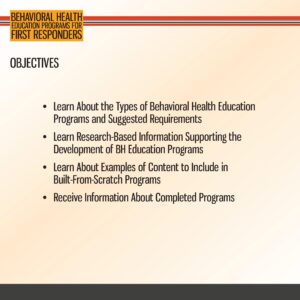
This module aims to provide the knowledge necessary to develop, implement or improve behavioral health education programs within your agency. You will learn about the various behavioral health education programs and the recommended training requirements for each. You will also have factual, evidenced-based information to aid you in advocating for such programs to become standard in your organization’s training curricula. You will be provided sample slides and links to online materials demonstrating effective training content if you build your education material from the ground up. If a completed product is better for your organization’s needs, you will receive contact information from those with premade materials ready for your consideration. It is pertinent to note that throughout this presentation and many other modules of the Behavioral Health Access Program Toolkit, the terms “behavioral health” and “mental health” are used interchangeably.
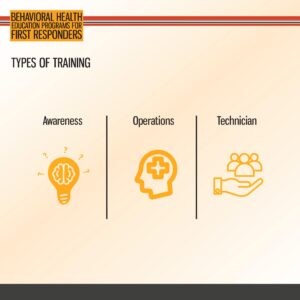
Types of Training
There are three types, or levels, of first responder behavioral health training described in this module. The recommended training type depends on each member’s rank and/or role within the organization. The three types of training include: Awareness Level, Operations Level, and Technician Level Courses. Awareness Level training should be conducted for all members of an organization. It is a foundational knowledge course providing an overview of many behavioral health topics. Operations Level training is designed for supervisors and higher-ranking first responders. It should cover multiple topics yet focus on how supervisors support mental health efforts within their organizations. Technician Level training is intended for peer support members and those in chaplaincy roles. The focus is skills-based, covering various advanced topics (specifically suicide prevention).
Awareness Level Training
We will start our discussion of the different types of Behavioral Health Education Programs by reviewing Awareness Level training, as it is the foundation upon which all other levels should be developed. The knowledge and skills presented in Awareness Level training are relevant to all members within an organization and provide each member a basic understanding of the following:
- What behavioral health is.
- What behavioral health is not.
- Why general knowledge of behavioral health concepts is relevant to them.
- Ways to cope effectively with personal and professional stressors; and
- How behavioral health services can be accessed if they or others are experiencing a behavioral health concern
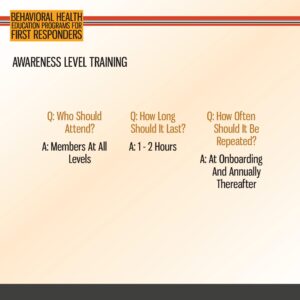
So if the question arises, “Who should participate in Awareness Level training?” the answer is “Everyone in the agency,” as no member is immune to experiencing mental health challenges. It is recommended that Awareness Level training last at least one hour but no more than two. Any longer than two hours and you may encounter several significant obstacles to effective training, including, but not limited to, scheduling conflicts or loss of engagement from your audience. Additionally, it is recommended that Awareness Level training be completed at onboarding and yearly after that, as this is consistent with many other pieces of training designed to keep members performing optimally.
Goals of Training
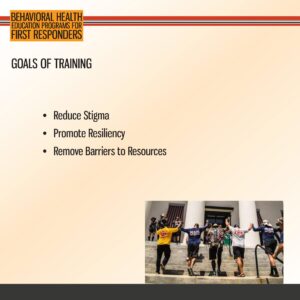
The three main goals of Awareness Level training are:
1. To reduce stigma – Speaking openly of mental health initiatives normalizes the subject and offers members a greater level of comfort when dealing with mental health concerns.
2. To promote resiliency -Training your members on adaptive coping strategies and informing them of the various avenues for seeking help strengthens their abilities to effectively handle stressors inherent to first responder professions.
3. To remove barriers to resources – Informing your members about the myriad of resources available to them enhances overall mental health awareness. It increases the likelihood that members in need of mental health support will receive the help they need and deserve in a timely manner.
How Do We Achieve Those Goals
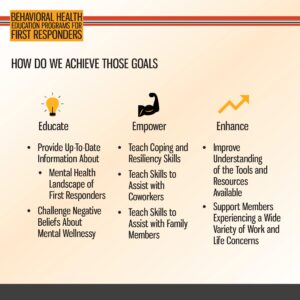
So how do we achieve the goals of Awareness Level training?
First, we educate our members agency-wide on the mental health risks faced by first responders today. In doing so, we provide them with the knowledge necessary to combat the centuries-old stigma that has plagued first responder service and contributed to the harmful yet prevailing belief that experiencing mental health concerns makes a first responder weak or inept.
Next, we empower our members by training them on the specific strategies to help first responders adaptively cope with stresses inherent to the job. In providing this information, we demonstrate continued trust in the first responder’s ability to problem-solve in challenging situations effectively. Additionally, we increase overall resiliency by helping members cope with stress as it happens rather than letting it build to the point that it becomes detrimental to the health of that member, their team, or their family.
We must also enhance members’ understanding of the tools and resources available to support them, regardless of what kind of challenges they may be experiencing. Though they do not need to know the details of every service, they need to know that support services exist, how services can be accessed, and where or who your member can go to if they have questions or concerns. It is important to note that it can be incredibly beneficial to highlight services that utilize culturally competent clinicians who understand the stresses specific to the first responder community. When treating mental health concerns, often the only thing worse than no help is the wrong help. If mental health providers are not familiar with the realities of the first responder service, they may exacerbate a member’s negative beliefs. This becomes apparent, for instance, when a member believes they are beyond help and the help offered is ineffective which further reinforces that belief.
Awareness Training Targets
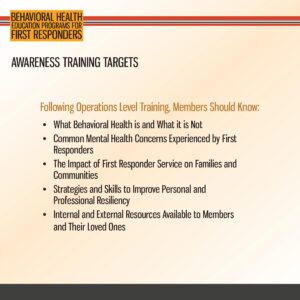
Upon completion of Awareness Level Training, your members should:
1. Possess a more accurate and comprehensive conceptualization of what “Behavioral Health” is and, equally important, what it is NOT.
2. Be able to better recognize the signs and symptoms of behavioral health concerns commonly experienced by first responders.
3. Objectively discuss the risks and rewards associated with first responder service for members, their families, and the broader community.
4. Demonstrate knowledge and practical application of the strategies that can help first responders maintain a healthy behavioral health baseline, resiliency, and the skills that aid effective recovery when personal or professional stressors result in undesired behavioral health consequences.
5. Understand how to access the behavioral health resources available to first responders and their families. This should include those resources directly available within the organization (such as a peer support team or chaplain) and those not directly affiliated and operate independently of the organization’s operations (such as a professional mental health treatment clinic).
Awareness Level Training
Should you be interested in a complete yet modifiable template of Awareness Level training, you may contact the UCF RESTORES Training Coordinator at REACT peersupport@ucf.edu for one potential option. Please see the Task Book at the end of this module for examples of training curricula you may tailor to meet your department’s needs.
Whether you develop your own Awareness Level training materials or you seek a completed product, we highly recommend you do what you can to customize the materials with information from your organization or field of service. Use of agency or profession-specific statistics, stories, standard operating procedures, logos, pictures, and other relatable content enhances the experience for your first responders and increases its relevancy to them.
2. Operations Level Training Overview
Audio
Transcript
Operations Level Training
Now, just as we did with Awareness Level Training, we will review the remaining levels of training by:
1. Providing a general overview of each training;
2. Detailing the specific goals of each training;
3. Discussing how the Educate, Empower and Enhance approach can be applied to achieve those goals;
4. Outlining the specific training targets for each level; and
5. Sharing examples of appropriate content that may be included when developing your organization’s behavioral health education programs.
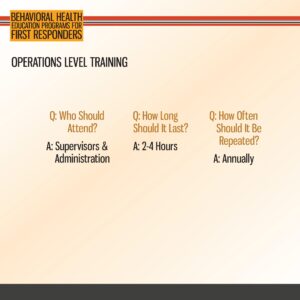
As discussed earlier, Awareness level training broadly covers several mental health topics and is relevant to all members of your organization. Operations-level training, however, should be geared more toward supervisors and executives as it builds upon the initial foundation already established in awareness-level training. It accomplishes this by looking at how those in leadership roles can further support members expressing the need for mental health help or resources. More so, it aids these same leaders in cultivating a culture of honesty and openness about the realities of mental health in first responder service. Due to the more extensive nature of what is covered, it is recommended that Operations Level Training last anywhere between 2 and 4 hours. And as with all behavioral health education training levels, it is recommended that Operations Level Training be completed annually to keep your members’ skills and knowledge sharp and up-to-date.
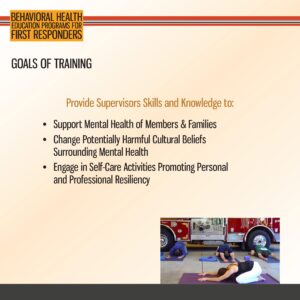
The three main goals of Operations Level Training are to provide supervisors and executives with the skills and knowledge necessary to:
1. Support the mental health needs of members and their families.
The leaders within your organization have a sacred duty to care for their team and account for the needs of the organization and the needs of the larger community they serve. It can feel tricky to strike the right balance, but Operations Level Training is an excellent opportunity to highlight how taking care of the mental health needs of members IS taking care of the needs of the organization and community, too.
2. Change potentially harmful cultural beliefs surrounding mental health. One of the most effective ways for leaders to support members is to normalize the mental health experiences of first responders and to destigmatize help-seeking behavior. In doing so, leaders cultivate supportive environments where members feel confident expressing their behavioral health concerns without suffering negative repercussions.
3. Engage in self-care activities that promote their own personal and professional resiliency. In engaging in these activities, leaders set a great example as to the effectiveness of appropriate stress management strategies. Furthermore, self-care increases the likelihood that leaders will adaptively cope with the increased stressors and responsibilities inherent to leadership roles.
How Do We Achieve Those Goals
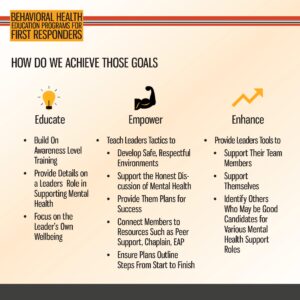
So how do we achieve the goals of Operations Level Training? Let’s revisit the Educate, Empower, & Enhance approach we used earlier in this presentation to answer this. First, we build upon the education component established in Awareness Level Training. As you will recall, Awareness Level Training provides factual information to first responders about various mental health-related topics when properly conducted. It supports general awareness of the realities facing first responders when it comes to experiencing and coping effectively with mental health concerns. Operations Level Training takes that a step further by providing leaders with the skills and knowledge necessary to identify members possibly dealing with mental health concerns while also providing information regarding the best practices for supporting those members throughout the entire help process. Additionally, it encourages leaders to think about how they must care for themselves so that they are optimally positioned to help care for other members on their team and their families.
Next, Operations Level Training attempts to empower leaders by providing them with the step-by-step plans for growing and maintaining mentally healthy and resilient teams. Having access to these plans improves the likelihood that leaders will cultivate professional cultures that respect the history of strength and stoicism in first responder service yet appropriately challenge outdated or harmful beliefs surrounding help-seeking behavior among first responders.
Last but not least, to achieve Operations Level Training goals, we must leverage our leaders’ insight about their teams and how the unique individuals comprising those teams respond to various situations. Awareness of each member’s weaknesses and strengths places the leader in a solid position to identify others who may serve as mental health advocates in the organization. This enhances any gains made by these programs.
Operations Training Targets
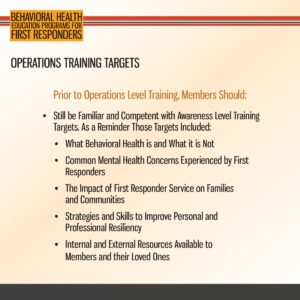
Again, we emphasize that Operations Level Training builds on the foundation outlined in Awareness Level Training. As such, it is important to note that the leaders participating in Operations Level Training should remain familiar and competent with the Awareness Level Training targets. They are listed here as a helpful refresher. They should: know what behavioral health is and what it is not, know about common mental health concerns experienced by first responders, understand the impact of first responder service on families and communities, know strategies to build resiliency, and know about internal and external resources available to first responders and their family members.
Operations Training Targets
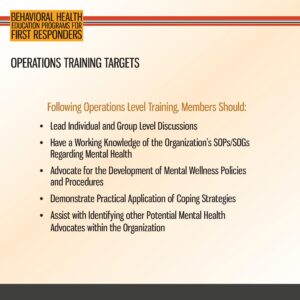
Following Operations Level Training, members should:
1. Be able to lead individual and group-level discussions on general mental health topics. The Awareness Level Training targets we just reviewed serve as great topic ideas.
2. Have working knowledge of the organization’s standard operating procedures and guidelines regarding mental health. For example, leaders should be familiar with the process for helping a member in need from the moment they are made aware of the mental health concern through follow-up that is conducted afterward. Leaders should also be aware of how these processes may be impacted depending on the acuity of the member’s need. How we help a member experiencing a normal trauma response to a bad call will look different from how we would help a member experiencing an active mental health crisis such as suicidal intent or plan. Leaders should also be able to educate their members on the benefits and risks of utilizing different forms of leave, such as workers’ compensation, FMLA, or personal time.
3. In the absence of these policies, the leader should advocate for developing and implementing such policies and procedures. This is necessary for the protection of both the organization as well as any members experiencing mental health concerns.
4. Demonstrate real-life application of the strategies to maintain or improve their own personal & professional well-being. Caring for others, though rewarding, is hard work. Nobody, not even the most seasoned leader amongst us, is immune from stress. As such, leaders must exemplify the same skills they encourage their members to use to cope with work and life demands effectively.
5. Serve a vital role in identifying other potential mental health advocates. As we’ve discussed already, leaders already possess a familiarity with their team members that allows them specialized insight into who could help advance a supportive mental health culture within the agency.
3. Technician Level Training Overview
Audio
Transcript
Technician Level Training
Now, just as we did with previous training levels, we will review recommended Technician Level Training requirements by:
1. Providing a general overview of the training;
2. Detailing the specific goals of this training;
3. Discussing how the Educate, Empower and Enhance approach can be applied to achieve those goals;
4. Outlining the specific training targets for Technician Level Training; and
5. Sharing links to possible resources to obtain examples of appropriate content or completed training materials.
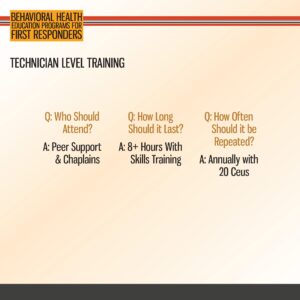
Technician Level Training is designed for peer support team members and chaplains. Due to these members’ highly specialized role in assisting others experiencing mental health concerns, the training is far more comprehensive than the other levels of training. Given the advanced nature of this training and the need for all members to be provided multiple opportunities to practice the application of the skills covered, training may last eight hours or more. Just as with the other trainings discussed thus far, it is recommended that Technician Level Training be conducted annually.
The three main goals of Technician Level training are to:
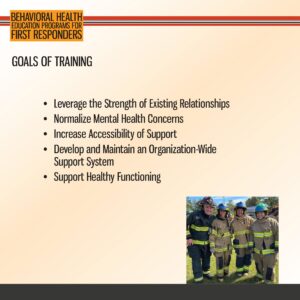
1. Leverage the strength of existing relationships to aid members experiencing various mental health concerns. Though members may not always trust mental health care professionals or similar providers, they may be receptive to support from somebody they already know and trust. Peer support members and chaplains are crucial to aiding these members who may otherwise not seek help.
2. Normalize mental health concerns and complexities so that members feel that they are able to reach out for help if needed.
3. Provide members with easily accessible support, particularly when experiencing suicidal ideation or other high-risk situations. Increasing support to our most vulnerable members when their need is greatest is one of the best steps we can take in our goal to save first responder lives.
4. Develop and maintain a comprehensive and well-rounded support system for the entire organization. By having existing members serve in these highly specialized yet fully integrated roles, we create networks of knowledge and support that are imperative to the healthy functioning of the members and the organization as a whole.
5. Support healthy functioning of each member, their family, and the department as a whole.
How Do We Achieve Those Goals
To achieve the goals of Technician Level Training, let us again apply the Educate, Empower, and Enhance approach we did with the previous training levels.
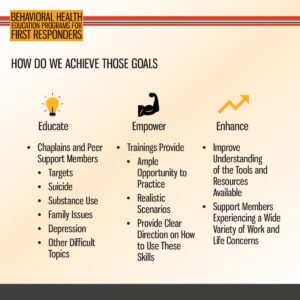
First and foremost, we must provide our chaplains and peer support members the knowledge they need to respond effectively to the varied mental health needs that first responders face as a result of their service. As we discussed earlier, first responders are more likely than the average citizen to experience challenges involving substance use, suicidality, depression, and family dynamics. Discussing these matters can be difficult for anyone, but with the proper training, our chaplains and peer support members can feel more confident in providing the assistance members need and deserve regarding these mental health topics.
Next, we must empower our chaplains and peer support members by giving them the time and resources necessary to practice their skills. Members selected for these roles have already demonstrated competency and reliability in numerous circumstances. These very admirable qualities should be recognized and rewarded by giving them time away from their traditional responsibilities to improve their skills and gain new ones. These skills will allow them to successfully navigate the challenging situations in which they are called upon to support members in need. And finally, we must enhance the overall culture surrounding mental health and increase the general support network by recruiting others to take a more active role in mental health advocacy within the organization. Peer support members and chaplains are excellent resources, but they, too, are human. As such, they are vulnerable to the same mental health stressors as every other first responder. The risk of burnout is increased since relatively few fill these specialized roles. Recruiting others to take more active roles could reduce this risk and help maintain healthy functioning for all.
Technician Training Targets
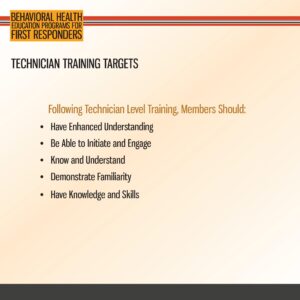
Following Technician Level Training, members should:
1. Have an enhanced understanding of the risks and warning signs of the most common mental health concerns experienced by first responders. This includes more in-depth knowledge of substance use disorders, suicidality, and trauma disorders such as PTSD, depression, and anxiety.
2. Be able to initiate and engage members in meaningful discussions of topics such as suicide, substance use, and family dynamics. Due to the highly personal nature of these topics, they are sometimes difficult for members to openly discuss, particularly when their mental wellbeing is suffering. Feelings of shame are common among members experiencing these kinds of challenges. Training in these topics can help chaplains and peer support members approach these topics in a manner that conveys empathy and understanding rather than judgment or ignorance.
3. Know the protocols for protecting and supporting members, particularly if they endorse suicidal or other high-risk mental health concerns. Advanced knowledge of these protocols ensures that the member in need receives support in the most effective and timely manner possible. And should a member be experiencing an active mental health crisis, every moment counts when it comes to saving their life.
4. Demonstrate familiarity with both internal and external resources. More so, members should demonstrate an ability to provide appropriate referrals and when to escort members to a higher level of care.
5. Possess the knowledge and skills necessary to engage family members in discussing first responder mental health. As much as first responders are highly skilled at compartmentalizing, family life is one of the primary aspects of their lives to be influenced by their service. Though this is not necessarily bad, it is still helpful for family members of first responders to receive psychoeducation about the impacts of service on their loved one’s wellbeing.
Technician Level Training
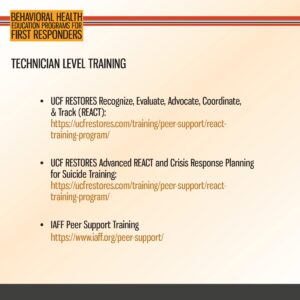
Listed here are possible resources for Technician Level Training. As a reminder, it is HIGHLY recommended that Technician Level Training focus on skills development. This is true regardless of whether you develop it specifically for your organization or seek a completed version of the training.
UCF RESTORES offers two training modules designed for those at the Technician Level.
1.REACT provides all participants with mastery experiences designed to give them challenges at which they can succeed, bolstering confidence in their ability to provide effective support to their peers. Course material is presented in a manner that places occupational principles and skills unique to first responders and healthcare workers within the framework of peer support. Through this program, participants learn how to recognize “stress injuries” and evaluate their peers’ mental health, offer peer– level support, and effectively coordinate necessary follow-up in the event professional intervention is warranted.
2.Advanced REACT and Crisis Response Planning for Suicide Training serves as a follow-up to the initial REACT training. In this training, participants learn even more about the best practices recommended for use when supporting a member experiencing a possible mental health crisis.
IAFF Peer Support Training is another option for Technician Level members. Per their website, “After completing the training, members have the necessary knowledge and skills to provide support to their peers, have a basic understanding of common behavioral health issues affecting the fire service, can serve as a bridge to community resources or behavioral health treatment when indicated, and are able to build or enhance their peer support programs.”
You will also find other examples of available trainings in the Task Book portion of this Toolkit. End of Module.
4. Education Task Book
This task book is intended to give you opportunities to build and evaluate behavioral health education opportunities for your organization. However, it is important to note that there are pre-built educational models available for developing behavioral health access programs for first responder organizations. These models have been developed and refined by reputable organizations and are based on extensive research and experience in the field. As such, it is recommended that these models be consulted and utilized as appropriate when developing a comprehensive program. Two such examples of pre-built models are the UCF RESTORES and 2nd Alarm Project. Links to these programs are provided for further reference and guidance.
Education links:
Awareness Level Training:
UCF Fire awareness level training
UCF Law Enforcement awareness level training
Other helpful links: