
Resources for Leadership – Kim Neisler
Transcript
Hi, my name is Kim Neisler. I’m a retired Fire Chief from the city of Maitland. Currently, I am the fire and EMS liaison for UCF Restores. As a leader of a first responder organization, you have the power to promote polices, practices, training, and an organizational culture that prioritizes the well-being of your members. Leaders that choose to invest and create comprehensive Behavioral Health Access Programs in their departments see the benefits of employee retention, reduced sick leave, improved working conditions, and better customer service within the community. This module will help you gain insight on the leadership specific considerations for building a BHAP that is tailored to your department and its members’ needs.
Leadership – Course Chapters
1. Benefits of BHAP and Leadership Training
Audio
Transcript
Resources for Leadership
Resources for Leadership Module. In this module, we will discuss leadership and the vital role that leaders play in the development of behavioral health systems, not just in policy but in creating a safe place that allows your members to access the highest, most competent levels of care. Leaders need to look at all the benefits that come with starting a behavioral health access program, such as employee retention, reduced sick leave, improved working conditions, and better customer service within the community.
Description
Building A Leadership Program and Changing Organizational Culture

By the end of this module, you will be able to identify the benefits of creating a BHAP, understand and begin to identify trainings for leadership, understand how to collect data and what type of data will be helpful to you, set goals according to your organizational needs, assess your operational environment, create policy that will fit your organization, understand how to make your program sustainable, and know how to identify and disseminate resources for your employees.
Description
Objectives
- Benefits of BHAP
- Trainings for Leadership
- Data Collection
- Quantitative/Qualitative
- Organizational Goal Setting
- Assessing your Operational Environment
- Policy making
- Sustainability
- Resources for your members
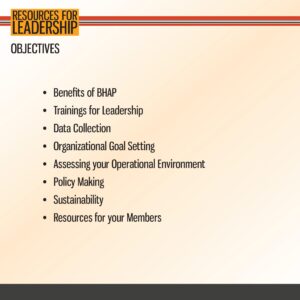
Benefits of a BHAP: Leadership Perspective
Having a healthy workforce is the main driving force behind creating a Behavioral Health Access Program, or BHAP for short. First Responders dedicate much of their careers to training and perfecting their trade. This is done in the hopes that they can make well-informed decisions when faced with unique, challenging, and sometimes life-or-death situations. Simply put, the reason we train is to keep us safe.
First responders and your organization may place a significant emphasis on maintaining a healthy lifestyle physically. While this is vitally important, more and more, we are learning that a healthy body, combined with a healthy mind will yield the best results.
By investing in Behavioral Health Access Programs, your members will be better equipped to handle the hard decisions about where to access support, by utilizing the tools you have given them. BHAPs will help to reduce member turnover, thus decreasing your onboarding and training costs and providing you with a more experienced workforce. Sick leave use is another area in which you will often see a reduction. Members of a healthier mind and body are less likely to frequently call in sick, thereby reducing the burden on other first responders that work in your department. The external customer will also benefit from your members improving their mental wellness. A healthy workforce directly correlates to an increase in customer satisfaction. Lastly and most importantly, the creation of a Behavioral Health Access Program can prevent loss of life due to suicide by your members. Suicides in the first responder community have been a concern for many years now. As we struggle to get a handle on this tragic reality, it is your duty as a leader to provide the best possible resources for members who may be struggling.
Description
- More effective members
- Higher return of investment through lower turnover
- Reduction in sick leave use
- Better community service
- Suicide prevention
- Reduced Substance misuse
Training Command Staff & Company Officers
As the awareness of first responder suicides and post-traumatic stress disorder rises, so do the number of trainings available to you as leaders of your organization. It often takes time to recognize what trainings would fit best for your organization. We recommend being as proactive as possible. Find training that will help you and your members face adversity. Practical resiliency and mental health awareness training help to create a healthier workforce. Additional training topics may include identifying barriers to your members seeking help, how to reduce stigma surrounding mental wellness, and how to change the climate of your organization. It is important that members understand how to seek help appropriately and that if they do so, they will not face punitive measures but rather the support and resources described throughout this Toolkit.
Description
- Resiliency, Mental Health, and Wellbeing
- Leadership Encouraging and Improving Resiliency
- Barriers to seeking assistance
- Organizational Climate Change through:
-
- Stigma Reduction
-
- Non-punitive atmosphere
-
- Fostering a climate of help seeking
Training Command Staff & Company Officers
It is easy to recognize the bravery required of someone who puts their life on the line to help others. What is often less understood is that the desire to help or “calling to serve” MAY come from personal adverse experiences and their own childhood trauma. The desire to be a person who can “put away the bad guy,” / “be there in a moment of crisis,” / “ save someone from danger,” / and “provide comfort and support” may come out of the lack of support they received personally OR in honor of those who helped them in a time of need. First responders are, at their core, “helpers” who seek to problem-solve and protect others during a crisis. They do this repeatedly, shift after shift, hoping to save lives – demonstrating their strength, resilience, and courage. It is important that command staff receive training on this dynamic. Along with the potential impact of repeated exposure to trauma in their jobs, staff needs training on how to maintain healthy brain functioning before and after trauma exposure, things to look out for that may indicate a member needs help, and agency-specific behavioral health data. We will give examples of these behavioral health data in the next section of this training.
Description
- Adverse Childhood Experiences and First Responders
- Trauma and the Brain
- Repeated Exposure to Trauma (RET)
- Indicators of Concern Among Members
- Agency Specific Behavioral Health Data for Leadership Review and Reflection
2. Organizational Assessment and Goals
Audio
Transcript
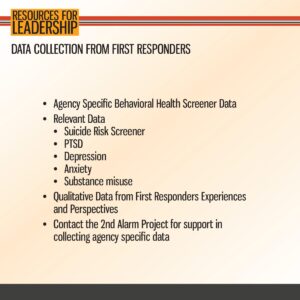
Data Collection from First Responders
It is important for agencies to collect member-specific data on mental wellness trends to train members at all levels on the dynamics that exist and, most importantly, to create systemic change in the organization that addresses the specific challenges their members face. Departments should collect qualitative data from their members utilizing validated tools that assess for suicide risk, PTSD, depression, anxiety, and harmful use of substances. Departments may also wish to collect quantitative data on the specific barriers that prevent first responders from reaching out for help and the behavioral health needs of first responders and their family members. The 2nd Alarm Project provides support to agencies as they develop their BHAPs. Our team can assist you in determining which data you should collect and how to utilize those data to help your members.
Description
- Agency Specific Behavioral Health Screener Data
- Relevant Data:
- Suicide Risk Screener
- PTSD
- Depression
- Anxiety
- Substance misuse
- Qualitative Data from First Responders Experiences and Perspectives
- Contact the 2nd Alarm Project for support in collecting agency specific data.
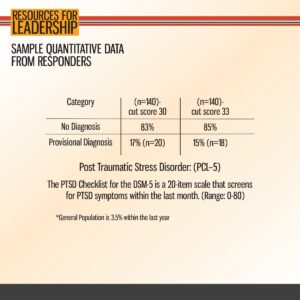
This sample quantitative data collected from 140 first responders shows that 15% of first responders in this data sample answered questions in a manner that indicates a provisional diagnosis of posttraumatic stress disorder based on symptoms reported within the last month. These rates are significantly higher than the general population.
According to the American Psychiatric Association, PTSD affects approximately 3.5% of U.S. adults every year in the general population. Collecting, analyzing, and utilizing these data can help leadership target specific areas of concern for their agency among their members.
Description
Post Traumatic Stress Disorder: (PCL–5)
The PTSD Checklist for the DSM-5 is a 20-item scale that screens for PTSD symptoms within the last month. (Range: 0-80)
*General Population is 3.5% within the last year
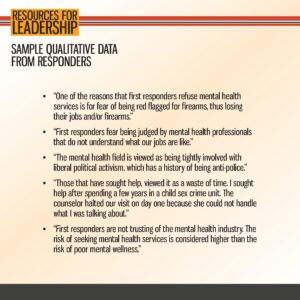
Sample Qualitative Data from Responders
These statements represent some of the qualitative data collected from first responders regarding why they and other first responders often do not reach out for behavioral health clinical services when needed. By collecting and analyzing qualitative data, agency leaders can see some contextual information about members’ experiences, fears, and viewpoints. These data are essential to the qualitative data so that leaders may see the bigger picture and understand the intricacies that first responders have expressed.
- “One of the reasons that first responders refuse mental health services is for fear of being red flagged for firearms, thus losing their jobs and/or firearms.”
“ First responders fear being judged by mental health professionals that do not understand what our jobs are like.”
- “The mental health field is viewed as being tightly involved with liberal political activism, which has a history of being anti-police.”
- “Those that have sought help, viewed it as a waste of time. I sought help after spending a few years in a child sex crime unit. The counselor halted our visit on day one because she could not handle what I was talking about.”
- “First responders are not trusting of the mental health industry. The risk of seeking mental health services is considered higher than the risk of poor mental wellness.”
Description
- “One of the reasons that first responders refuse mental health services is for fear of being red flagged for firearms, thus losing their jobs and/or firearms.”
- “First responders fear being judged by mental health professionals that do not understand what our jobs are like.”
- “The mental health field is viewed as being tightly involved with liberal political activism, which has a history of being anti-police.”
- “Those that have sought help, viewed it as a waste of time. I sought help after spending a few years in a child sex crime unit. The counselor halted our visit on day one because she could not handle what I was talking about.”
- “First responders are not trusting of the mental health industry. The risk of seeking mental health services is considered higher than the risk of poor mental wellness.”
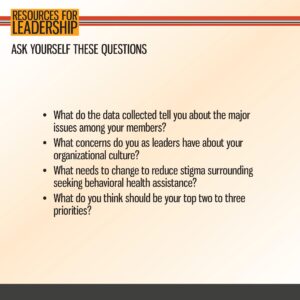
Ask Yourself These Questions
As a leader, it is important to ask yourself and your leadership team these questions. What does the data tell you? What type of issues is your organization facing? Are these issues unique to you, or is this a problem that is common among many first responders? What kind of culture does your department have, and how can you as a leader change this culture? Who can start to break down the stigma? Who do you need as your internal mouthpiece or spokesperson? What other entities within your agency, union, human resources, and leaders within your municipality can assist you with finding solutions to these problems?
Finally, identify your top three priorities as a leader regarding mental wellness. Once you identify your specific priorities, you can utilize these properties to guide you in the rest of your decisions as you plan and implement your Behavioral Health Access Program.
Description
- What do the data collected tell you about the major issues among your members?
- What concerns do you as leaders have about your organizational culture?
- What needs to change to reduce stigma surrounding seeking behavioral health assistance?
- What do you think should be your top two to three priorities?
Determine Your Organizational Goals
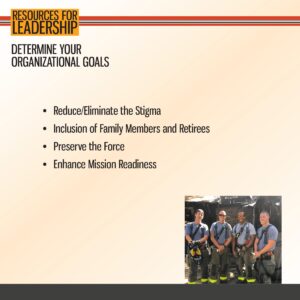
While your specific mental wellness goals may vary from the list here, often, we can find commonality within. For example, if your top priority is to increase longevity and reduce turnover, you can do this by reducing the stigma surrounding mental wellness. Families and retirees often serve a vital role in this area. The family is typically more tuned-in to the changes seen within your members, and the retirees may offer a unique perspective. Also, ensuring the wellness of retirees and family members will enhance your memberships’ well-being by default.
Do your mental wellness goals include preserving the force? Enhancing mission readiness?
Understanding what goals are the most important to you will enable your organization to focus in on the priorities that will impact your members the most and produce the best possible outcomes.
Description
- Reduce/Eliminate the Stigma
- Inclusion of Family Members and Retirees
- Preserve the Force
- Enhance Mission Readiness
Assess Your Operational Environment
It is essential to compile an overview of your system and the resources that will fit within it. Specific factors that may apply to you and your agencies are unique and do not apply universally. Does your area have a rich pool of well-informed and culturally competent clinicians? Or is it difficult to find mental health providers with a background in the first responder community? Do you employ an Employee Assistance Program or EAP for short, and if so, what are the program’s specifics? For example, how many visits do your members get, how are the providers chosen, what type of specialty focus areas are available and missing when searching for providers, and what other services does that company offer? For instance, family support, financial support, substance use, and marriage counseling. What are the needs of your specific demographic?
Is your agency condensed in a small area or are your responders spread throughout a large county? Is your community rural, urban, suburban, or a combination?
Do you have the budget to implement a robust BHAP or will you need to find the means to operate within a tighter budget? How will this program be sustainable? Who will oversee this program? In many cases, the Health and Safety Officer will oversee the overall program and assign each portion to someone else.
Do you have the backing of your agency? How will you present this program, and what will they need to see regarding the benefits to their organization? Lastly, as this initiative grows, an ever-growing amount of data is produced with it. As we discussed previously, collecting member-specific data is critical. Additionally, the 2nd Alarm Project and UCF Restores are two valuable organizations that provide additional resources and evidence-based, data driven information on BHAPs for first responder organizations.
Description
- Provider Capabilities and Shortfalls
- Capabilities of EAP Program
- Rural and/or Urban Geographic and Demographic Differences
- Budget (constraints, restraints, and sustainability)
- Political Support
- National and Local Data on Behavioral Health Concerns and Advancements for First Responders
3. Policy Making and Sustainability
Audio
Transcript
Creating BHAP Related Policies
Developing a comprehensive BHAP policy can be daunting, requiring careful consideration of many moving parts. It is crucial to approach this policy with a focus on encouraging members to seek help rather than imposing punitive measures that could discourage them from reaching out.
When crafting the BHAP policy, reviewing and building each component with the overall summary in mind is essential. The language and tone used in the policy can make a significant impact on how members perceive it and whether they are willing to seek help.
While it is crucial to emphasize the importance of seeking help, the policy should still specify the consequences of substance misuse, such as failed drug tests. This can be achieved without adopting a punitive approach.
One critical aspect of the BHAP policy is determining whether members will be allowed time off to seek treatment. This component should be carefully considered and clearly outlined in the policy.
Lastly, the BHAP policy must have a well-developed plan for reintegrating members into the workforce after seeking treatment. This plan should be tailored to the individual member’s needs and include appropriate support and resources, as well as measures for protecting the members’ confidentiality, to ensure a smooth transition.
By emphasizing the importance of seeking help, developing appropriate consequences for substance misuse, allowing time off for treatment, and providing comprehensive support for members during the reintegration process, organizations can create a policy that encourages a culture of support, openness, and understanding around mental health and substance use concerns.
Description
- Time Off Needs (Outpatient, Inpatient, and Residential)
- Reintegration Supports (After Residential Stay, Attempted Suicide, etc.)
- Substance Use/Misuse Policies
- Encouraging Help Seeking Behaviors
- Seeking Help Appropriately will Not Impact Job Retainment, Pay or Career Progression
- Protecting Confidentiality of Members in Peer Support Encounters and While Seeking Other Assistance
As you begin the development of your policies or as you audit the policies already in place, the approach should be to maximize mission performance. The guidelines that will assist your members in achieving a healthy mindset will increase that mission performance. Knowing this allows you to seek out and implement programs that may have been considered unconvenient until recent years. Programs that focus on your retiree demographic, family support, and spiritual guidance can create a “whole health” approach to the behavioral health aspects within your organization. Vetting the facilities you will be sending your members to and designing systems with those facilities that allow your members to remain dignified are all factors you must address as a leader. Knowing what a return-to-work status involves within your organization, the workers’ compensation system, and about health insurance providers will reduce any unforeseen issues that may arise with a mental wellness-related injury. Lastly, crafting a message from you directly that validates a member who may be seeking help is one more step in reinforcing the importance of this program within your organization.
Description
- First Responder Support
- Support for Family and Retirees
- Crisis Intervention Process
- Return to Work Process
- Statement Validating Members Seeking Help
Creating BHAP Related Policies
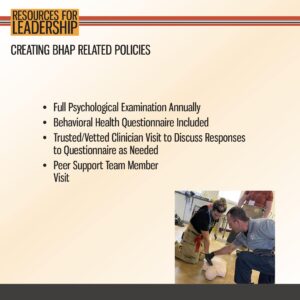
One key policy to consider is to provide a psychological examination annually. This allows members to assess their mental health and well-being and identify any areas of concern that may require further attention. Additionally, including a behavioral health questionnaire as part of the annual process can help members acquire additional insight into their mental health and well-being. The clinician should review the questionnaire before the exam and discuss any aspects that may be addressed. A high priority should be placed on ensuring that your members trust the clinician. The additional support can help members address any issues identified in the questionnaire and provide guidance on maintaining good mental health.
Peer support team members can also be used as valuable assets in reaching out to your members and establishing trust. In addition to setting up visits with a trusted clinician, consider incorporating station visits with peer support team members. These settings can provide a relaxed setting for your members to connect with the team and discuss any concerns they may have. Creating opportunities for your members to feel comfortable discussing behavioral health topics will foster a culture of openness and encourage seeking help when necessary.
Description
- Full Psychological Examination Annually
- Behavioral Health Questionnaire Included
- Trusted/Vetted Clinician Visit to Discuss Responses to Questionnaire as Needed
- Peer Support Team member Visit
Creating BHAP Related Policies: Peer Support
Peer support is an integral component of any BHAP policy, and as such, it is essential to create formal policies surrounding its implementation. A formal charter should be developed, outlining the role and authority of the peer support team. It is crucial to establish clear guidelines on who can be a part of the team and what the selection process and criteria are. A reporting structure should also be developed to ensure that the team is held accountable, and their efforts are effective. Finding empathetic and caring individuals who have shared experiences with your members can create a sense of community and provide a valuable support system. The peer support team can be the backbone of your BHAP policy. By investing in its development, you can improve your first responders’ mental wellness and maximize mission performance. More information on building a robust peer support program can be found in the peer support section of this Toolkit.
Description
- Formal Charter
- Authorities Given to the Peer Support Team
- Personnel Selection Process and Criteria
- Reporting Structure
*See Peer Support Section of the BHAP Toolkit for More Detailed Information on Peer Support Team Structure and Policies.
Education and Training Programs
Education and Training Programs are crucial to any effective BHAP. As an agency, consider initiating an educational continuum that begins during new-hire training and continues throughout the career progression of your members. Additionally, providing educational programs for retirees and their families can promote overall wellness and improve mental health. These programs should cover topics such as resiliency, communication, financial planning, family and relationship tools, and navigating through retirement. By offering comprehensive education, your agency can improve your members’ work-life balance and potentially reduce sick time and divorce rates. Providing ongoing training engagements can also serve as an opportunity to reinforce these essential skills and promote a culture of wellness within your organization.
Description
Consider:
- Education Continuum Initiated at New Hire Training
- Continuous Education Requirements throughout Career Progression
- Retiree Education Programs
- Family Orientation and Ongoing Training Engagements

BHAP Sustainability
The sustainability of your BHAP is critical to its success, and this sustainability should start at the inception of the program. It is essential to have leadership and key stakeholders agree on the BHAP model and related policies. This will provide you with the buy-in necessary for the success of this program. Annual reviews of the program and policies, along with measuring outcomes, will justify program budget support. Data on program cost and return on investment should also be tracked to justify the program. Continuous quality improvement is key to ensuring the program is working well and improving other strategies as needed. Sustaining what is working well and adjusting what is not will ensure the program’s longevity. With the right leadership, buy-in from stakeholders, and a commitment to continuous improvement, your BHAP can be sustained and produce positive outcomes for your organization.
Description
- Leadership and Key Stakeholder Agreement on the BHAP Model and Related Policies Needed
- Annual Review of the Program and Policies
- Outcomes Measuring Program Success and Justifying Program Budget Support
- Program Cost and Return on Investment Data
- Continuous Quality Improvement: Only Sustaining What is Working, and Improving Other Strategies as Needed
Additional Considerations for Leadership
As you develop your BHAP, you must work with the authorities within your agency to ensure maximum benefits. Your human resources department or staff person can offer guidance on improving existing systems, while city/county administration and elected officials can provide the necessary support for successful implementation. Ensuring your leadership and Chief Officers have bought into the program is crucial. They must provide a safe place for members seeking support and help break down mental wellness stigma. Creating appropriate support for leadership experiencing behavioral health concerns will enhance their overall well-being, allowing them to lead by example and support their team members. Lastly, knowing and upholding Florida Statutes related to first responder behavioral health and peer support is essential. This allows you to evaluate what is expected, understand your responsibilities, and guide peer support members while maintaining confidentiality.
Description
- Working with Authorities Having Jurisdiction;
- City/County Administration
- Human Resources
- Elected Officials
- Creating Appropriate Supports for Leadership Experiencing Behavioral Health Concerns
- Understanding, Upholding, Implementing, and Facilitating Florida Statutes related to First Responder Behavioral Health and Peer Support
Florida Legislation
Florida Statute chapter 112. section 1815 Includes standards for determining the compensability of employment-related Post Traumatic Stress Disorder, or PTSD, under Worker’s Compensation insurance for first responders. The law allows first responders that meet certain conditions to access indemnity and medical benefits for PTSD without an accompanying physical injury.
Furthermore, subsection (6) of this statute directs that “An employing agency of a first responder, including volunteer first responders, must provide educational training related to mental health awareness, prevention, mitigation, and treatment.”
Description
Florida Statute 112.1815
PTSD Workers’ Compensation Coverage and Mandatory Education on Mental Health Awareness, Prevention, Mitigation, and Treatment
Florida Legislation
Florida Statute chapter 111. section 09 defines peer support in first responder-employing agencies as, “The provision of physical, moral, or emotional support to a first responder by a first responder peer for the purpose of addressing physical or emotional conditions or other issues associated with being a first responder.”
Furthermore, this statute defines peer support communications, the confidentiality of peer support encounters, and limited exceptions to the confidentiality provision, such as: the first responder receiving peer support, giving permission in writing to share the information, the peer supporter suspecting criminal activity, or the peer supporter fears for the safety of the responder or others due to the information disclosed during a peer support encounter.
As statutes continue to change, we encourage you to maintain an awareness of the most up-to-date laws regarding first responder mental health in Florida.
Description
Florida Statute 111.09
Defines Peer Support in First Responder Agencies, Peer Support Communications, the Confidential Nature of Peer Support Encounters, and the Limits to Peer Support Communication Confidentiality
Providing Resources for Members
The remaining sections of the BHAP Toolkit will lead you through the creation of BHAP components within your agency. Think of the BHAP components like a menu in which education for all members in the foundation. Agencies often choose to build Peer Support Teams simultaneously with education initiatives since peer support is a critical component to enhancing responder mental wellness. It is important that members have clear, consistent, and widely available information about accessing peer support team members as well as outpatient and inpatient clinical services. As agencies grow their BHAPs, they should focus on all aspects of the BHAP model in an order that fits their size, specific needs, and capacity. A comprehensive BHAP includes resources for prevention, early intervention, and postvention services to support members at all levels of the behavioral health continuum.
As described in the BHAP Framework section of this Toolkit, it is important to regularly assess the effectiveness of all aspects of the BHAP, including, but not limited to, clinician availability, member utilization rates, and satisfaction with services and programs. If services are not proving effective for your members, make the necessary adjustments and reassess effectiveness after a specified amount of time.
Description
- Through BHAP Framework, provide;
- Links to Peer Support
- Links to Clinicians
- Include Resources for;
- Prevention
- Early Intervention
- Postvention for Members
- Regularly assess utilization rates and member satisfaction with Employee Assistance Programs and/or other clinical services provided by your agency.
Resources
The BHAP Toolkit was built for you as a leader of first responders. The attached task books are provided to you as way to map the development of your program. In these task books, you will find valuable resources such as templates, evaluation metrics, and sample standard operating procedures and guidelines. These are provided as a way to kickstart your program and help you develop this essential part of your organization.
If there is anything you need that you have not been able to locate in the BHAP Toolkit, please contact the 2nd Alarm Project so we may assist you further.
Description
Thank you for reviewing this training module.
Please see the resources for more in depth information on many of the included topics.
4. Leadership Task Book
First Responder Behavioral Health Access Program Leadership Task Book
Introduction: Briefly summarize the purpose and goals of the Behavioral Health Access Program (BHAP) for first responders.
Section 1: Planning and Preparation
- Identify key stakeholders and establish a Planning team.
- Develop a detailed project plan with clear timelines and milestones.
- Conduct a needs assessment to identify the behavioral health needs of first responders.
- Develop a communication plan to ensure all stakeholders are informed and engaged in the process.
Section 2: Implementation
- Assign roles and responsibilities for the implementation of the behavioral health access program.
- Develop and implement training programs for first responders and their supervisors to increase awareness and reduce stigma around behavioral health issues.
- Establish a process for mental wellness related issues and ensure all first responders are aware of the resources available to them.
- Develop and implement a system for tracking and monitoring the utilization of behavioral health services.
Section 3: Evaluation and Continuous Improvement
- Establish metrics for evaluating the success of the behavioral health access program.
- Collect and analyze data to measure the effectiveness of the program and identify areas for improvement.
- Use the data to adjust the program and ensure that it remains relevant and effective.
Conclusion:
- Summarize the key tasks and responsibilities for leadership in the development and implementation of a first responder BHAP.
- Emphasize the importance of ongoing evaluation and improvement to ensure the program remains effective and meets the needs of first responders.