Outpatient Services – Chris Cruz
Transcript
My name is Chris Cruz, Battalion Chief with the Lake Mary fire department behavioral Health Access Programs, or BHAP for short, include the development of behavioral health clinical services for first responders, retirees, and their families. Most departments have employee assistance programs, which is part of the BHAP. However, many departments have found the need to improve or expand on employee assistance program services provided to their members. This module will discuss the development of these outpatient behavioral health resources in partnership with trusted clinicians that are trained to work specifically with first responders and their family members.
Outpatient – Course Chapters
1. Behavioral Health Overview
Audio
Transcript
Outpatient Behavioral Health Services
Outpatient Behavioral Health Services. In this module, we will discuss the information necessary for establishing or improving your organization’s Behavioral Health Access Program by focusing on Outpatient Services.
Though we as a collective society have come a long way in understanding and treating behavioral health concerns, particularly within the last century, the concept of “behavioral health” remains confusing, scary, or stigmatized for many. In this module, we will start by considering the following: What is meant by “behavioral health,” and why does it matter? In doing so, we aim to promote acceptance of behavioral health as a universally experienced aspect of each person’s overall well-being rather than an affliction of which to be afraid or ashamed. Afterward, we will look at specific steps and special considerations when growing the outpatient services portion of your organization’s Behavioral Health Access Program. Emphasis will be placed on using a proactive approach with team members. Using the provided framework and information, we are confident that you and your organization will feel empowered to take on this challenging but crucial life-saving task.
What Is Behavioral Health?
When you hear the term “behavioral health,” what comes to mind for you? If asked to define it, what would you say? If you don’t know, that’s okay. As mentioned previously, the concept of behavioral health is still not well understood by many people today, despite incredible advancements in the comprehension of behavioral health conditions and their treatments in recent years. This section will provide a helpful conceptualization of behavioral health. More so, it will challenge you to consider why behavioral health matters, not only for the team member utilizing the BHAP but also for you, your organization, and the community at large.
What Is Mental Health?
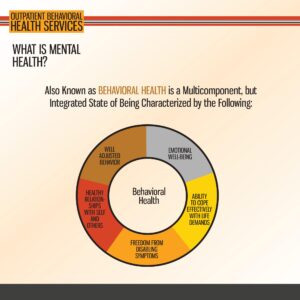
As shown here, behavioral health, also commonly referred to as mental health, comprises multiple components that come together to make each of us who we are. It is a dynamic state of being that includes our external behavior, emotions, relationships with self and others, and ability to deal effectively with responsibilities and stress. It also consists of any symptoms that we may have, physically and psychologically. Each component can influence the others. For example, when a first responder works a demanding shift in which they receive very little if any, rest, they may become more irritable than usual. This may lead to them behaving in ways they typically wouldn’t, such as being short or sarcastic with others. This could contribute to a disagreement between the first responder and their significant other, causing both to experience feelings of anger and strain in their relationship. In this hypothetical, yet likely relatable, scenario, we can clearly see how an impact in one component of this behavioral health wheel ultimately impacted all components of it. It is important to note, however, that human beings are incredibly resilient creatures. Setbacks such as those described in the scenario are often temporary. Additionally, the fact that an impact in one component can impact others can be a good thing. Not all impacts are bad and taking steps to strengthen one’s behavioral health in one area, can help promote strength and resiliency in all areas.
Behavioral Health: Why It Matters
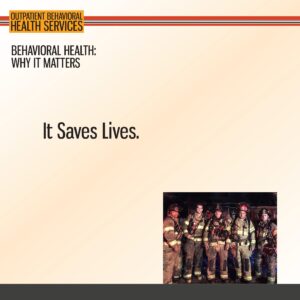
Now that we have a better understanding of what behavioral health is, it is important to note what it is NOT. Behavioral health is not a term solely reserved for those who are struggling with distressing symptoms or diagnosable conditions such as Major Depressive Disorder or PTSD. Nor is behavioral health a sign that somebody is weak, broken, or incapable of handling difficult things. Instead, as we’ve already established, behavioral health is a fundamental aspect of one’s entire being. This is true for each one of us. For too long, behavioral health has been treated as a taboo topic. This is particularly true for cultures that pride themselves on mental and physical strength, courage, and self-reliance, such as those within first responder services. Though these traits are admirable and undeniably necessary to first responders, they can occur in excess and ultimately become a barrier to seeking much-needed support. When behavioral health concerns are not normalized and addressed early, they have the potential to grow into seemingly insurmountable problems and leave one wondering, “Why bother?” Left further unsupported or untreated, these concerns can lead to long-term negative outcomes and even death. By distinguishing between what behavioral health is and is not, we are better able to delineate why behavioral health is so significant to the well-being of individuals, families, organizations, and communities at large. Moreover, we can save lives.
Behavioral Health: Why It Matters
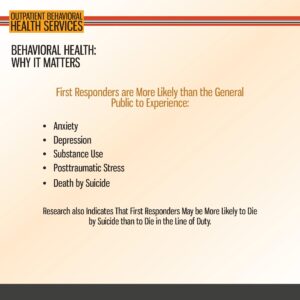
It is no secret that first responders are a rare breed. In fact, first responders make up slightly more than 1% of the entire U.S. population. This may not be surprising considering what is expected of the modern-day first responder. First responders repeatedly confront the uncomfortable, the painful, and the dangerous at the possible cost of their own lives, all to protect and serve others in need. Our towns and country overall are safer because of their selfless service, because of YOUR selfless service. But due to these repeated exposures and other stressors associated with the job, such as long, unpredictable work hours, interruptions to necessary life functions like sleeping and eating and working with outdated or hazardous gear, first responders are more vulnerable to experiencing a wide range of behavioral health concerns. And this is not just by subjective report. Research supports this finding as well. Consider the following: Research shows that approximately 30% of first responders develop clinical-level mental health conditions compared to only 20% of individuals in the general population. Research also suggests that firefighters are 2 to 3 times more likely than the average citizen to engage in binge drinking, a behavior associated with numerous public and personal health risks, including unintentional injuries, unwanted pregnancy, sexual assault, violent death, cancer, and SIDS.
Further research indicates that law enforcement officers are twice as likely as other employed U.S. population members to have depression and sleep disorders such as insomnia or sleep apnea. Additionally, they are also more likely to go untreated. Perhaps the most disturbing is recent research that reveals first responders are currently more likely to die by suicide than in direct line of duty circumstances. All these studies highlight we need BHAPs more than we ever have.
Behavioral Health: Why It Matters
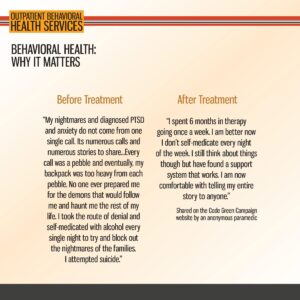
In this powerful testimony shared by an anonymous paramedic, we are provided real insight into the struggles that our first responders sometimes experience in relation to their service. Nightmares. Overwhelming anxiety. Excessive alcohol use to cope with trauma. Attempted suicide. None of these have to be the reality for our first responders. As illustrated later in this same testimony, there is hope. Our first responders can get better with the proper support, which sometimes includes outpatient mental health treatment. Presumably, with the proper support, we can prevent these kinds of stress injuries from happening at all. Comprehensive BHAPs will serve as a cornerstone to ensuring that first responders can easily access services and care at all levels of need.
Behavioral Health: Why It Matters
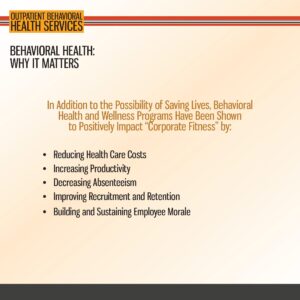
In recent years, workplace culture has become an increasingly hot topic for many companies across the nation. Organizations from a myriad of backgrounds have spent an unprecedented amount of time and energy trying to understand the best ways to improve their workplaces and help their employees survive and thrive, personally and professionally. Though the motivations of these companies could be argued all day long, there are undeniable benefits afforded to companies that take this approach. Among those benefits are reduced healthcare costs, increased productivity, decreased absenteeism, improved recruitment and retention, and a boost in employee morale. Simply put, supporting employees makes them better employees; better employees equals better business. It really is that straightforward.
The BHAP Framework
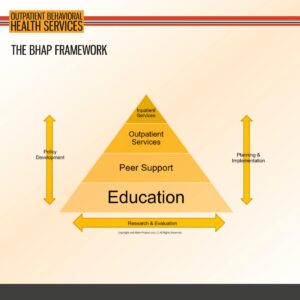
Now that we’ve established what behavioral health is, what it is not, and why it is vital to the healthy functioning of individuals, families, organizations, and society at large, let’s look at the core elements of a comprehensive BHAP. In this illustration, a comprehensive BHAP is conceptualized as a pyramid. Each layer of the pyramid facilitates and supports the adjacent layers. Additionally, all layers are flanked on each side by the undeniably crucial elements of policy development, planning and implementation, and research and evaluation. This module will focus primarily on the development of outpatient services and will reference several of these elements.
2. Identifying Outpatient Resources
Audio
Transcript
Outpatient Services
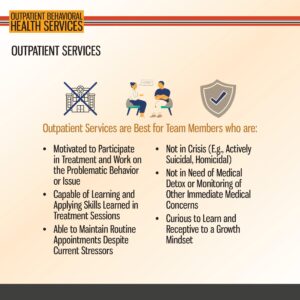
So, what is meant by outpatient services? Outpatient behavioral health services are provided to an individual or group in an office, or clinical setting but do not require an extended stay, as might be required if they were hospitalized. Outpatient services are often the best option as the structure and requirements are minimally invasive to the team member’s life. The team member can typically maintain involvement in their usual activities at home, work, and social settings, as appointments usually take only an hour or two per week. Services provided at this level can help prevent the situation from escalating to a severe level that would necessitate more intensive or long-term services. As this slide highlights, there are key factors to consider when determining if outpatient services may be a good fit for a team member. These factors include the team member’s motivation for problem-solving, ability to learn and apply skills, ability to maintain routine appointments, and overall mindset toward growth and improvement. It is imperative to note that outpatient services are NOT a good fit for team members who are actively in crisis or in need of consistent monitoring due to medical reasons, including the need to detox from substance use. For these team members, inpatient services are highly recommended.
At the end of this presentation, you will be provided with a list of possible resources to consider when growing your BHAP. This list will include outpatient service providers, such as UCF RESTORES and 2nd Alarm Project’s 10-4 Center for Responder Resiliency. These providers have been previously vetted by first responders who are active in mental health advocacy efforts in Florida and the rest of the Nation.
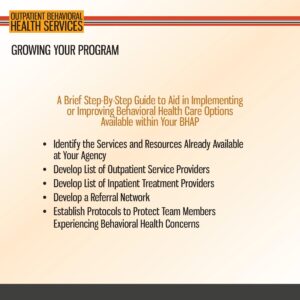
Taking on the task of establishing or expanding even one element of your organization’s BHAP may feel like an incredibly daunting task. However, following this simple step-by-step guide will provide a framework for success when growing the behavioral health care options available. It takes the complex and breaks it down into manageable parts that can be addressed in a progressive or as-needed fashion by a single individual or an entire team. It all starts with knowing what services are already available to your organization. Being aware of this in advance prevents potential redundancies in work and thus the possibility of wasting precious time and resources. Next, you want to start developing your lists– one for outpatient service providers and the other for inpatient treatment providers. As we’ve mentioned, this module focuses on outpatient services. But as all first responders know, it pays to be prepared, and having options is rarely a bad thing, so you’ll want to know of some inpatient providers just in case. Lists are no good, though, if we don’t do something with them. So, after deciding who you will add to your list of providers, it is time to make the connections that will count, or in other words, grow your network. And lastly it is essential to work with leadership to establish the protocols that will protect team members experiencing behavioral health concerns. We can’t make sustainable change and reduce the stigma surrounding behavioral health if team members feel they will suffer negative consequences or be punished for seeking help.
Identify The Resources Already Available To You
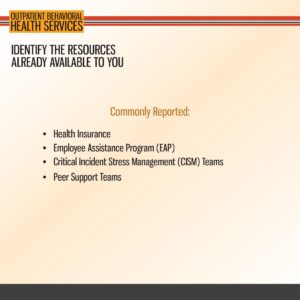
Many first responders are familiar with the concept of a scene size-up. Though the specific verbiage or acronyms used may vary depending on the agency, location, or type of service, an important part of any properly performed size-up includes determining what resources you have at your disposal. This will allow you to handle the situation as efficiently and safely as possible. The treatment of behavioral health concerns for first responders is much like a scene size-up. We need to determine who needs assistance delivered in which ways as well as what resources we have available to us so that we can get the first responder (and possibly their family) the help they most need and deserve. When thinking about this from an outpatient services standpoint, the most common resources include health insurance providers, employee assistance programs, critical incident stress management (CISM) teams, and peer support teams. Take a moment to think of your organization. Is there anything listed here that your organization currently lacks but for which you could advocate? Is there anything not listed here that you could add?
Special Considerations
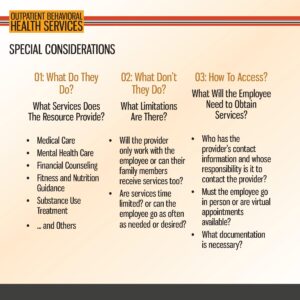
Knowing the names of resources available to us is one thing, but to truly maximize the potential benefits associated with each resource, we must take it a bit further by asking ourselves the following questions: What do they do? What don’t they do? And how can they be accessed? Think of each resource as a tool. You don’t have to be an experienced craftsman to use tools, but you at least need to know when the job at hand calls for a hammer and when it calls for a sledgehammer. The same is true when it comes to knowing what tools are in your outpatient services “ toolbox.” You don’t have to be an expert on each and every one, but familiarizing yourself with basic information about the services each resource provides, limitations associated with each resource and requirements for obtaining services ensures the job gets done right. And more importantly, by having this information readily available, you remove one of the most significant barriers to behavioral healthcare for team members seeking assistance. One of the worst things that can happen to a first responder who finally asks for help, is to be met with a bunch of frustrating obstacles, such as being guided to a provider who is inappropriate for their needs.
To help combat uncertainty regarding various services or the processes to access them, it can be helpful for the mental health advocates in your organization, such as peer support team members, to attempt the process themselves. Even if they do not need full services, the advocate or peer support member will gain valuable perspective on what the process entails. Suppose a process is too complicated or confusing – it may be a good indication that they do not want to refer members experiencing mental health concerns to that service. As it may exacerbate the problems they are having.
Outpatient Service
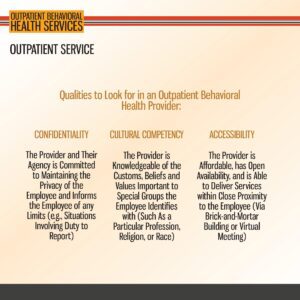
Regardless of the nature of services offered, there are three essential qualities that any provider should possess before being considered as an option for your members. The first is confidentiality. All individuals seeking mental health care deserve to have their privacy respected. They should be able to freely express thoughts and feelings without fear of judgment or the possibility of their information being negligently released to others. Any legitimate mental health provider understands that the stories shared with them are extremely meaningful and the trust it takes to share them is sacred. However, providers are also legally and ethically bound to break that confidentiality in certain circumstances, such as cases involving the abuse or neglect of a vulnerable population. In such cases, providers have a duty to report relevant information to the proper authorities. Individuals should be aware of any such limitations by the provider before engaging in treatment.
Second, the provider should have cultural competency. Often when people think of culture, they think of things like race, ethnicity, or religion. However, culture is comprised of other things, too, such as one’s profession. This is particularly true for first responders, who frequently liken their jobs to a “calling” and pride themselves on values like courage, competency and strength. It is also important to account for the stressors unique to first responder professions, including the immense amount of time they neglect their own basic needs to care for others, the constant expectation to do more with less, and their repeated exposure to traumatic events. Team members are more likely to benefit from services when paired with providers who honor their experiences and understand the extraordinary demands expected of them as public servants. Third is accessibility which is simple–obtaining services shouldn’t prove more of an obstacle than it is an opportunity.
Vetting A Provider: What To Ask
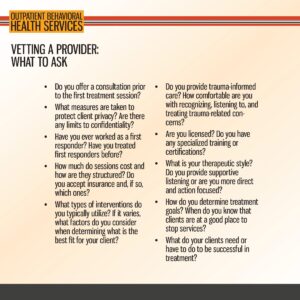
A 2019 survey by the Florida Department of Children and Families revealed that the State has nearly 44,000 actively licensed providers working in behavioral health-related professions. With a number like that and recognizing that not all providers are created equal or qualified to serve the distinct needs of first responders, it’s easy to see how vetting potential providers could feel like an impossible task. However, you don’t have to start from scratch. Later in this module, we will provide you with information on several resources that have already earned recognition for their work with first responders in need of behavioral health services. You will also be provided with information to databases containing the names of clinicians who have successfully completed specialized trainings designed to enhance their ability to provide culturally competent care specific to first responders. That said, the fact that a provider may not be listed via one of these resources does not necessarily mean they are incapable of serving the needs of your team member or organization. It just means it may take a bit more time to determine if they are a good fit, and that’s okay. A little extra time on the front end will save you and your team members a lot of aggravation in the long run. So, when meeting with a new provider, prepare yourself by developing a list of questions that will empower you to learn more about the provider and how they may, or may not, be able to serve your team members. The questions here are suggested as a starting point, though the list will likely grow depending on you or your organization’s goal for the provider-client relationship. Furthermore, you can encourage any team members directly seeking support to also ask these questions prior to receiving services. It may help them feel more comfortable with the process and allow you to routinely confirm that the provider’s answers remain consistent over time.
Please Note
Though this presentation focuses on outpatient services, one of the steps of growing your BHAP is learning about and building sustainable relationships with inpatient treatment providers. The importance of this step cannot be overstated. It is a crucial part of growing your BHAP as inpatient treatment is imperative to saving the lives of team members experiencing active mental health crises, including those planning or attempting to die by suicide. Inpatient services are also best for team members who require constant monitoring to aid in their recovery for other reasons. This could include team members with significant comorbid medical concerns or needing medically monitored detox from substance use. To prevent unnecessary delays in getting team members the treatment they need and deserve when experiencing acute concerns such as these, the development of your BHAP should also include organization-specific protocols and guidelines on how to care for them during their times of need. Be proactive in establishing the means to keep you and the team member safe, including everything from the moment you become aware of the crisis through their return to the force, if applicable, and follow-up. For more information or guidance in this area, specialized training on inpatient treatment services is available via the Tactical Resiliency Toolkit. It is highly recommended for all organizations looking to implement or improve this aspect of their BHAP.

3. Additional Considerations and Resources
Audio
Transcript
Special Considerations
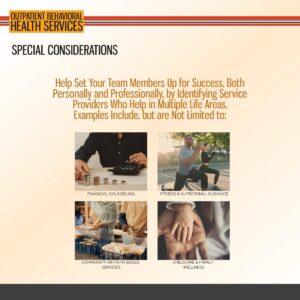
As you will recall, behavioral health is a multicomponent way of existence for all of us. That said, not all concerns that team members bring to you will require direct behavioral or mental health treatment. Despite their heroic characteristics, first responders are just as vulnerable to everyday life stressors as the public they serve. Thus, we suggest you also develop a list of other services that could assist team members. Examples of these services include but are not limited to the following: financial counseling; fitness and nutritional guidance; community or faith-based services; and childcare and family wellness providers. By having these resources available, you can improve your team members’ abilities to effectively cope with stressors before seeking clinical services.
Now that we’ve covered the importance of identifying your existing resources and developing your lists of outpatient and inpatient providers, we are moving on to step 4–growing your network. This section will expand upon information presented in early slides by providing practical tips and advice for developing your behavioral health care options under the larger umbrella of your overall BHAP. Our hope is that this information will simplify the challenging, though hopefully rewarding, work you are doing to improve the lives of first responders.
Warning
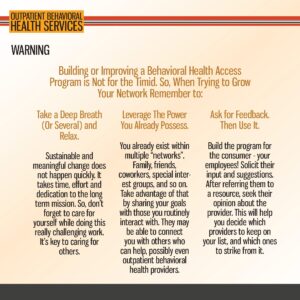
As with any component of this BHAP, it is essential to note that this is a time-consuming and taxing undertaking. Please understand that building this component has the potential to last a very long time. It is important to continue to use your methods of self-care for yourself. This work is a group effort, not a solo project. Rely on the systems and people you already have in place, ask them for assistance, and see if these resources already exist in your area. Reach out to other departments around you. Share your goals and build your programs in unison. This will divide the workload and produce a more robust program through information sharing and development. Finally, ask your members for recommendations. Tap into the clinicians that are already providing effective treatment within your organization. You may find your members to be hesitant about sharing at first, but if you create avenues for them to do this without some of the common concerns that come with sharing, you will find that there may already be an effective network in use.
Growing Your Network
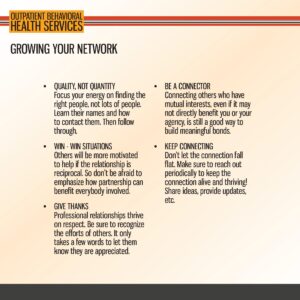
Growing a network of behavioral health care options for your BHAP isn’t much different than growing a network for any other purpose. Armed with the information in this presentation, including the questions to ask any potential providers, you already know a great deal about what to do and what qualities to look for when building potential provider–client relationships. The steps listed here will further your success, particularly when sustaining meaningful connections to providers you’ve learned are credible, competent, and worthy of working with your first responders.
Protecting Members
Before we conclude this module, we ask that you take a moment and truly consider what is being done to protect team members within your organization who express behavioral health concerns. Among the top reasons cited by first responders for not seeking behavioral health treatment is stigma and the associated fear of negative repercussions, such as being placed on special duty status that prevents them from doing the job they love and providing for their families. First responders’ jobs are inherently risky, but they don’t have to be made more so by practices, or lack thereof, that fail to support them when they need it most. So, we recommend your BHAP team be very intentional about instituting policies that provide specific protections for team members who are brave enough to seek help. Here are a few things to consider when drafting the policies for your organization: After referring a team member to services, who, if anybody, is responsible for following up? Does that team member’s request for services have to be documented, and if so, how do we ensure only those with a need to know can access it?
What should be done if a team member reports that they are suicidal? How do we keep members safe until we can get them into treatment? What if they do not want to go to the same facilities where they deliver patients and know the staff? What if a team member reports that they are homicidal or that they perpetrated some form of violence on another? What if that violent act was committed on a protected class such as a child, elderly person or person with a special condition or disability? Though this list is by no means exhaustive, it does serve as a demonstration of the importance of being proactive. Don’t wait until confronted with one of these situations before you think about what is expected of you or anyone else within your organization. Protect yourself and protect them.

Resources
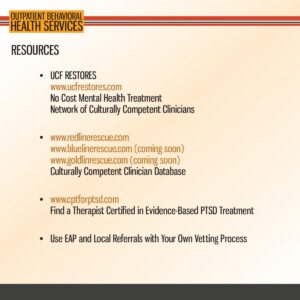
As previously mentioned, here are resources that serve as a great starting point if you are looking to implement or improve the behavioral health care options available under your organization’s BHAP. These resources have already been thoroughly vetted and proven to have a long-standing history of success in treating the unique needs of first responders. You will also find a taskbook attached. This will give you an outline of items discussed in this module and enable you to systematically develop the outpatient component of your BHAP.
End of Module.