Family Support – Milton Smith
Transcript
I am Milton Smith with all first responders banner creating a family support program as a part of your department′s BHAP can be a tremendous benefit to your members. Family support programs include much needed education and behavioral health resources for spouses, children, and other family members of first responders. In addition, when family members are brought into the fold, know what challenges to look out for, and how to best support their first responder, we can prevent some of the most tragic mental health outcomes for first responders in our work. This module will provide you with an overview of first responder family support programs and ways to get started building this important BHAP component.
Other Modules
Family Support – Course Chapters
1. Challenges and Best Practice
Audio
Transcript
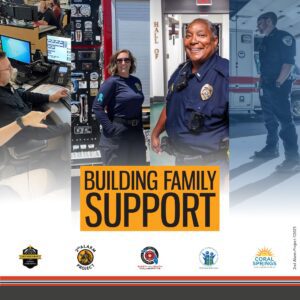
Building Family Support
Building family support, in this module we will discuss building family support. Families are first responders largest social support group and any all-inclusive behavioral health access program will adopt, include, and utilize this under resourced group in their organizational plan.
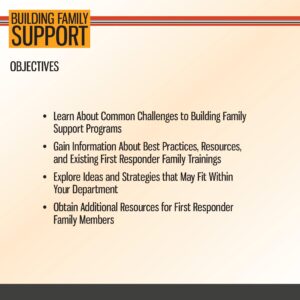
The objectives of this Toolkit Module are to learn about common challenges to building family support programs; gain information about best practices, resources, and existing first responder family training; explore ideas and strategies that may fit within your department; and obtain additional resources for first responder family members.
Common Challenges
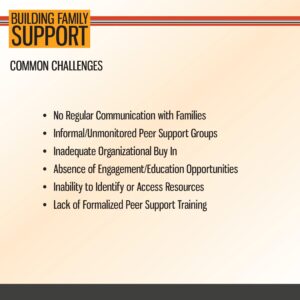
The responsibilities of first responder’s family members differ from those working in other professions. Therefore, creating family support in your department can significantly improve mental health outcomes for the first responder. However, there are several challenges and gaps that this group faces, including:
1. A lack of regular communication. Often, families have no direct communication from their first responder’s organization. During times of high stress, like difficult responses their loved one is on, families generally must rely on media or word-of-mouth information for updates. This can lead to a host of issues.
2. Informal/Unmonitored family peer support groups. These include communication through social media and group messaging through available cellphone apps. While this form of peer-to-peer interaction is not all bad, unless closely monitored, family members have self-reported issues such as “cliques” among individuals, conversations about topics that the department would not condone, and the disbursement of inaccurate information. This can lead to higher rates of mental health challenges for first-responder families.
3. There is a lack of organizational buy-in regarding supporting first responder families, the largest social support group of first responders. Families are usually only considered when dealing with a department tragedy. By implementing a family support component of a Behavioral Health Access Program, families are proactively made part of the solution to improved mental wellness.
4. The complete absence of engagement and educational opportunities for the first responder family. The more we teach our families, the better prepared they are to support their first responder and other first responder peer family members. They should be made part of the solution!
5. The inability to identify or access department, local, state, national benefits and resources for first responders.
6. Lack of formalized peer support training for first responder families can pose challenges and risks. Often family members go to other family members to talk, but many of them don’t have formalized peer support training, so they do not know how to identify someone who needs help.
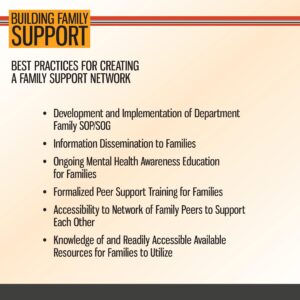
Best Practices for Creating a Family Support Network
Now that common challenges in developing a family support in Behavioral Health Access Programs have been identified, let’s cover best practices for creating your family peer support network. Throughout this module, you will be provided with information on how to develop and implement a standard operating procedure for Family Support, some advice on how to disseminate information to the families of your members, how to find and provide education to your members, what formalized peer support training for families consists of, how to gain access to a network of family peers to support each other, and finally, additional resources for family support.
2. Policies and Training
Audio
Transcript
Implementation of SOG/SOP
Let’s begin with the development and implementation of family support standard operating procedures and guidelines in your department. In order to build family support services for your department, you must first acknowledge the need for it within your Behavioral Health Access Program. First responders are more at risk for PTSD, suicidal ideation, alcohol and substance misuse, anxiety, and depression than the general public. Families make up the largest social support group for first responders. By including families in your Behavioral Health Access Program, you are developing and empowering your first responders’ largest social support group to be a part of the solution toward first responder mental wellness.
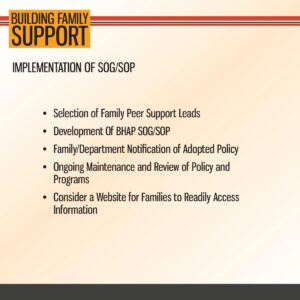
What should the implementation of standard operating procedures include? A successful family support procedure or guideline should begin with a selection of family peer support leads. Family peer support leads should include a department liaison and at least one volunteer family member. A formalized interview process to select representatives of families should be considered. Like selecting a department peer support member, the family member should have effective communication skills, critical thinking abilities, teamwork attitude, and trust amongst their peer group.
Once peer leads have been selected, the next step should be developing and implementing a department family standard operating guideline or procedure that aligns with the department’s BHAP. Family peer support allows families to support each other and provide education to improve early identification of mental health challenges in their loved ones. Just like other components of the BHAP, it should include a mission statement, confidentiality agreements, the adoption of formalized peer support training, a department-approved means of communication, new family orientation, continuing education for first responder families, a code of conduct, and a class on preparing for the family transition into retirement. Just like any other department policy or procedure, the family standard operating procedure or guidelines should be regularly reviewed and maintained in order to meet the needs of first responder family members. This includes tracking of family contact and usage of peer support and resources. Your family lead should also report any issues or program gaps to continue making improvements to the initiative regularly. Lastly, departments should consider building a centralized website specifically for first responder family members of the department where they can readily access information, communication, policies and procedures, peer support, and resources.
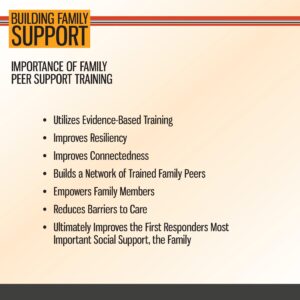
A comprehensive Behavioral Health Access Program family initiative should provide formalized peer support training, not only for the benefit of the first responder but for the benefit of other first responder families that may be in need. Any peer support training should be based on evidence-based practices, providing families with proven tools and resources to identify, interact and help someone in need. Providing first responder families with trainings like this will improve their resiliency, the family’s resiliency, and overall connectedness, thus reducing some of the barriers to care.
Much like the development of peer networks within a department, peer support training helps build networks of trained family peer supporters, which ultimately helps improve first responder mental health and peer-to-peer interactions between first responder families. With formalized training and the building of a family peer network, a department can vastly improve its reach and maximize this largely untapped resource. Studies show that the largest alleviation of burden for someone with a mental health challenge is connecting with someone who truly understands what they are going through. Moreover, a person who needs help is more likely to seek it if someone close to them recommends it. Who better than a first responder’s largest social support group, their families, to do this?
Evidence Based Training
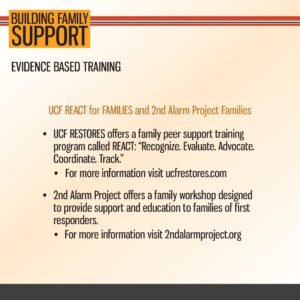
The University of Central Florida REACT for Families Peer Support Training was created specifically for first responder families. REACT provides all participants with mastery experiences designed to give them challenges at which they can succeed at bolstering confidence in their ability to provide effective support to their peers. Course material is presented in a manner that places occupational principles and skills unique to first responders’ families within the framework of peer support. While UCF offers peer support training specifically for first responder families, it is essential to note that they do not provide clinical services for families unless they personally experience adult trauma.
The 2nd Alarm Project offers a Family Workshop designed to provide support and education to families of first responders. The workshop includes topics such as stress management, coping skills, and communication strategies. The workshop also provides an opportunity for families to connect with one another and share their experiences. The goal of the Family Workshop is to help families understand the unique challenges faced by first responders and to provide them with the tools they need to support their loved ones. The workshop is typically held in-person but may also be offered virtually.
New Family Orientation/Academy
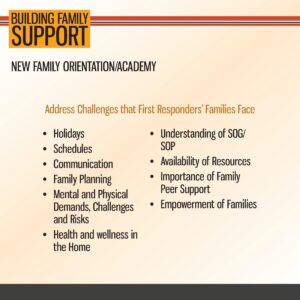
New family orientation should be considered a foundational part of the department’s family support initiative. New family orientation should include educating families about more than the bravado of the job. Families should be armed with the knowledge and resources to combat some of the common challenges faced by first responders and their families.
The program should address the unique schedules of the job and how it affects family planning and holidays. Families should be taught early and often about the mental and physical demands, challenges, and risks associated with being a first responder. This way, they can be aware of key changes in their loved one’s behavior or moods instead of making excuses for them or worse, internalizing them. Help guide families to create a communication plan with their first responder. For example, how will my spouse convey they had a bad shift or aren’t ready to talk about the bad call they ran? Teach them the nuts and bolts as it pertains to maintaining health and wellness in the home, including proper uniform washing, especially for firefighters. Build an understanding of all the resources and support the department’s BHAP offers.
Most importantly, empower families with connectedness, communication, and education so they can be resources to their first responder and other peer family members.
3. Additional Resources
Audio
Transcript
Transitioning to Retirement
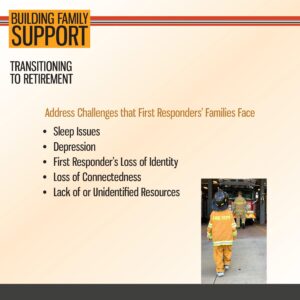
Transitioning from first responder to retirement is often a tenuous process for the entire family. A family Behavioral Health Access Program should provide information, webinars, or learning sessions on preparing to shift into retirement. It should address the common challenges that families encounter and how to support their family and loved ones through this process.
The information covered should include the topics of sleep issues, depression, and loss of identity and connectedness and provide resources for the families on how to support and assist their first responder in seeking care. Empowering families to be involved throughout their first responder’s career, including retirement, can yield significant positive changes in identifying and addressing mental health challenges earlier, contributing to better outcomes.
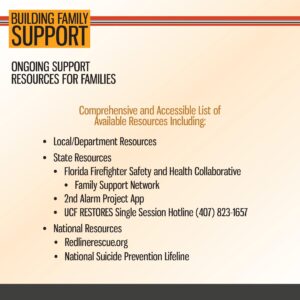
Support resources for first responder families should be in a centralized location that is easily accessible. These resources may come in the form of a link where a lot of helpful information is housed but is not necessarily appropriate for your standard operating procedures or guidelines. A centralized website will allow for continuous updates, communication, and up-to-date resources. Consider including the following and a clear explanation of what each resource offers:
‑Department resources and Behavioral Health Access Program Plan, which first responder families can access. For example, how to access EAP resources or chaplaincy and more about those resources.
‑Local resources such as department-recommended therapists
‑State resources, including the most current legislation on mental wellness and cancer presumption, and organizations to assist with these matters. Some of these resources include; Florida Firefighter Safety and Health Collaborative, 2nd Alarm Project, and UCF Restores.
‑National resources available to responder families such as the International Association of Firefighters, The International Association of Chiefs of Police, National Volunteer Fire Council, relinerescue.org, and National Association of Police Organizations.
By including families in your Behavioral Health Access Program, you make families a part of the solution. We can educate and empower families to affect change as we combat stigma and improve department policy to support a first responder willing to step forward for help.
Resources
Thank you for reviewing this training module. Please see the resources below for more information on many of the included topics.
4. Family Support Task Book
Download FAMILY SUPPORT TASK BOOK
Disclaimer: The Family Support Task Book is a comprehensive tool designed to help first responder agencies establish and maintain effective family support services. However, we recognize that smaller agencies may not have the personnel or funding to carry out all the tasks included in this task book.
For smaller agencies, we recommend focusing on the most critical tasks first, such as developing a family support policy and identifying a point of contact for families. These agencies may also consider partnering with neighboring agencies or community organizations to share resources and provide more comprehensive family support services.
Additionally, smaller agencies may find it helpful to seek guidance and support from state or national organizations dedicated to supporting first responder families. These organizations can provide valuable resources and expertise to help smaller agencies establish and maintain effective family support services.
Ultimately, the goal of the Family Support Task Book is to improve the support provided to first responder families. We encourage all agencies, regardless of size, to prioritize family support and take steps to establish and maintain effective family support services.