Resources for Clinicians – Jeff Orrange
Transcript
Hi, my name is Jeff Orrange. I’m the Toolkit coordinator for the Second Alarm Project. I’m also the Statewide peer team coordinator for the Florida Firefighters Safety and Health Collaborative. As clinicians, you will be asked to provide care for a unique and oftentimes challenging demographic. In this module, we will provide you with resources that will help you better understand and treat the first responder population. Your role in the wellness of this population cannot be overstated. In this module will serve as another tool to help you care for these men and women.
Other Modules
- Introduction
- BHAP Framework
- Leadership
- Retiree
- Peer Support
- Chaplaincy
- Outpatient
- Family Support
- Inpatient
- Education
- Critical Incident
- K9 Support
- Resources for Clinicians
Resources for Clinicians – Course Chapters
1. Introduction
Audio
Transcript
Resources for Clinicians
Resources for Clinicians. The Resources for Clinicians Module is an introduction for mental health professionals who wish to work with first responders and their family members. Additionally, clinicians who provide services through the 2nd Alarm Project and UCF RESTORES receive training on working with first responders and their families.
By the end of this presentation, clinicians will be able to meet the following objectives:
- Identify first responder symptoms of secondary levels of stress due to repeated exposure to trauma
- Recognize barriers to treatment
- Define successful evidence-based therapies utilized when working with first responders and
- Understand practices that build necessary knowledge and skills for serving first responders
Who are First Responders
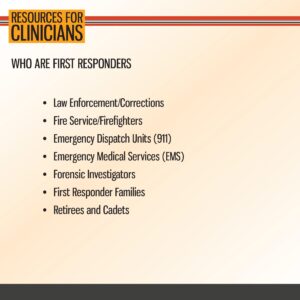
First responders are typically highly trained and certified to respond to emergency situations, such as accidents, medical emergencies, fires, natural disasters, manmade disasters, terrorist events and other mass traumas. They are responsible for the protection and preservation of life and environment during an emergency and throughout the recovery of an event. The 2nd Alarm project designates first responders to include:
- Law Enforcement, including those working the front lines in corrections.
- Fire service personnel, which includes firefighters, rescue personnel, prevention officers, inspectors and investigators.
- Emergency dispatch units including 911 and other designated dispatchers.
- Emergency medical personnel both public and private services, and
- Forensic Investigators who generally collect essential evidence from the scenes of crimes
Additionally, 2nd Alarm recognizes that first responders do not carry the weight of their profession alone. Not only do first responder families commonly have several family members who serve, but family members, especially parents and spouses, may experience secondary trauma [ie. Hypervigilance about the safety of their first responder family member(s)] within the family unit.
First responders and cadets in active service often are the beneficiaries of mental wellness program services, however retired first responders may not have had an opportunity to receive mental health services during their active career and may struggle with their past experiences as well as their transition into retirement. As a result, it is critical that families and retirees have access to and can benefit from mental health support.
Who are First Responders
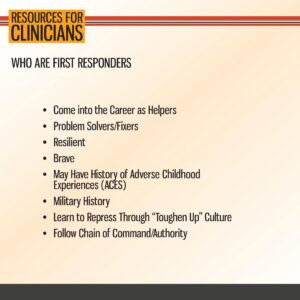
It is important to recognize the characteristics and traits of the people who serve as first responders. It is easy to recognize the bravery that is required of someone who puts their life on the line to help other people. What is often less understood is that the desire to help or “calling to serve” may come from personal adverse experiences and/or their own childhood trauma. The desire to be a person who can “put away the bad guy” / “be there in a moment of crisis” / “save someone from danger” / and “provide comfort and support” may come out of the lack of support they received personally OR in honor of those who helped them in a time of need. In this way, first responders and mental health providers have something in common! Like many clinicians, first responders are at their core “helpers” who seek to problem solve and protect during a crisis. They do this time and time again, shift after shift, in hope of saving lives demonstrating their strength, resilience and courage.
When discussing adverse experiences with first responders, we need to avoid over sympathizing. For example, most Type A personalities don’t want anyone feeling sorry for them. Instead, they want to be validated through statements such as, “I could see how that could be extremely stressful” or “That must have been very hard”. Also, when discussing Adverse Childhood Experiences, it is important to note that everyone experiences these events very differently. What impacts one person in a potentially devastating manner may be experienced by another as a minor challenge in their life.
Because of the danger present in carrying out their job duties, there is typically a high regard for the structure of the force they belong to. The necessity to follow the chain of command can be a matter of safety‑ life and death. The closed culture of first responders comes out of the need to trust each other with their lives. For families with generations of first responders participating in the culture can become a fundamental part of the person’s identity and they may have grown up with an understanding of the importance of the command structure. First responders with military backgrounds often have a similar understanding of this culture. No matter how someone comes into the role, the nature of the work facilitates a “toughen up culture” where individuals are both explicitly and inexplicitly encouraged to limit their feelings in order to carry out their job responsibilities.
It is important to note that while on scene, first responders must limit the expression of their feelings to do their jobs. Furthermore, at the point in which the sympathetic nervous system is activated, the prefrontal cortex is deactivated; biologically speaking both cannot function simultaneously. Thereafter, muscle memory takes over ‑ deactivating the sympathetic nervous system. Engaging in conversation (prefrontal cortex) helps reestablish correct processing of the event.
2. Common Dynamics & Barriers
Audio
Transcript
Compassion Fatigue
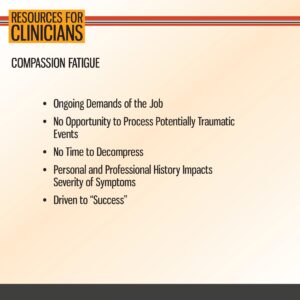
First responders carry a tremendous amount of stress within their jobs. Often the shifts are long and sometimes they don’t end until a job is done. They encounter traumatic events frequently and may not have the time to process an event before having to manage another possible crisis. Even if the event is not distressing to the first responder, they are managing and accessing individuals who have found the event disturbing. They likely encounter reminders/triggers of prior events on calls, which can pose a challenge. Sometimes those triggers may be related to their own personal experiences, dually impacting them by bringing earlier trauma exposures to surface. The interweave between personal trauma, on the job trauma and having empathy for others’ traumas can be overwhelming and may contribute to an impaired ability to maintain the emotional, physical and mental demands of the job. This may result in compassion fatigue out of a need for self‑preservation, causing a myriad of personal and professional consequences for the individual.
Recognizing Coping Strategies
To counter the ongoing stress, trauma and demands of the work, first responders develop coping strategies that can be both adaptive (healthy) or maladaptive (unhealthy). Without the ability to process or manage these day-to-day experiences even healthy coping strategies may become unhealthy. Some common strategies first responders use include:
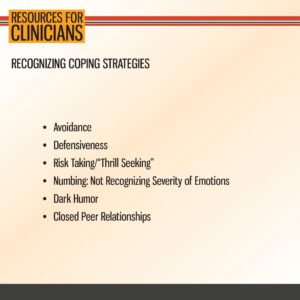
- Avoidance: Avoidance can provide short term relief and act as a distraction. Gaming, substance use, or social withdrawal may all be avoidance strategies that temporarily provide relief but that may create more stress or problems with long term use. This may be termed compartmentalization which may be helpful in the moment but is not often a good long-term coping strategy.
- Defensiveness: Lashing out, sarcasm, lying/covering up feelings can all be forms of defensiveness or denial. Defensiveness can include using rationalization, reasoning or intellectualizing a problem in place of dealing with emotions.
- Extreme Activities: risk taking/ “thrill seeking”: First responders may engage in extreme versions of sports, or risk-taking activities such as cliff jumping, skydiving, rock climbing or racing. Individuals who are used to high levels of anxiety and stress may seek higher risk activities to “let off steam”, maintain adrenaline highs, or counter numbness. Extreme sports can also be a positive life affirming experience that highly trained individuals find challenging and rewarding.
- Numbing/desensitizing: not recognizing severity of emotions: First responders often learn to become desensitized to the situations they respond to daily. While this can help them maintain professionalism and address crisis situations, it can become harder to recognize feelings, including symptoms of depression or anxiety that can have personal consequences.
- Dark humor: sometimes referred to as morbid humor, is the casual referencing of violence, cruelty, suffering and/or death in sometimes graphic ways that are meant to be funny. While not everyone appreciates this type of humor, first responders are more likely to poke fun at these serious and often taboo themes. Dark humor can reflect cynicism or irony used because of desensitization.
- Closed peer relationships: first responders are likely to hang with other first responders or professionals from similar fields, and first responder families because there is a sense of familiarity and comfort among others for whom there is a great level of trust. They are less likely to need to explain themselves or try to accommodate people who do not understand first responder culture.
Symptomology and Experiences
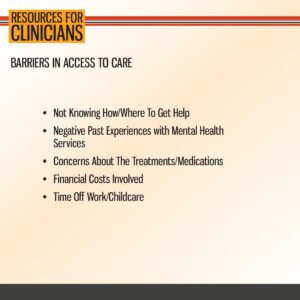
First responders have higher rates of PTSD, depression, substance abuse and suicidality than non-responders. A recent study has suggested that 30% of first responders have experienced PTSD (SAMHSA). Additional research suggests that of those first responders who have PTSD, 20% have a substance abuse disorder (CDC). First responders may also experience depression/suicidality, anxiety or substance abuse without clinical diagnosis of PTSD.
PTSD may have existed prior to becoming a first responder but be triggered by work exposure. Thoughts and feelings of suicide may also be triggered by moral injury, which is the psychological, behavioral, social, and sometimes spiritual distress/damage done to one’s conscience or moral compass when that person perpetrates, fails to prevent, or witnesses events that contradict deeply held moral beliefs and expectations. Guilt, shame, disgust and anger are common reactions of moral injury.
Clinicians must have a broader understanding of suicidal presentations. Just because a person says, “I wish I could end it” and has access to lethal means doesn’t necessarily mean we need to immediately move to Baker Act, take their weapons, and car keys. With the proper training, we can guide these thoughts to a better understanding, therefore eliminating suicidal thoughts. Clinicians must use caution and their own best judgment in this situation of course. However, learning more about the intricacies of suicidality and suicide ideation is critical when working with first responders.
First responders may also experience adjustment disorders with anxiety, depression or mixed features that are complicated by their work experience-for example, a newly retired first responder may struggle with their sense of self and/or purpose in addition to feeling symptoms related to decompressing from years of crisis response and chronic stress. Physical symptoms from chronic stress, such as GI issues, headaches, or high blood pressure may cause further distress. Physical injuries from work may result in similar symptomology. First responders are used to “powering through” and may not recognize any of these symptoms as impairment, as a result it is critical to recognize the potential of comorbidity to appropriately work with and treat each individual.
Most first responders will come to you with multi‑layered situations, what problems they are presenting with and what they want you to see vs. what is hidden from the clinician and maybe even from themselves.
Introduction to Therapy
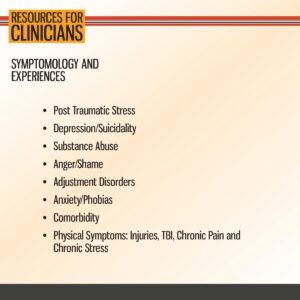
First responders may have prior counseling experiences that are rooted in interpersonal, social and professional “problems”. They may have received therapy to address prior personal traumatic or adverse experiences. More often however, first responders are introduced to counseling out of a necessity related to interpersonal conflicts that can include relationships issues, recognized substance abuse problems, anger management, and other work or legal problems. They may be required to receive counseling as a disciplinary action, work performance concern or legal issue that occurred outside of the workplace (interpersonal violence or domestic violence). When counseling is mandatory, the first responder may feel compelled to meet the minimum requirements to maintain their job, stay in good standing with their family and/or superiors, and meet policy regulations without getting much personally from the counseling. There may be fears of confidentiality or other barriers that create conflict in the therapeutic relationship and successful treatment.
Mental health stigma is an ongoing concern. Thankfully, the stigma is starting to lose its power but still exists in first responder culture.
Barriers in Access to Care
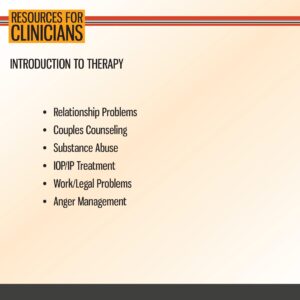
Because first responders are used to being resilient and high functioning in many ways, they may believe they can solve whatever problem is occurring or expect that it will simply improve over time. They may also rely on other first responders who already serve as a social support and sounding boards, believing that they are the most likely to understand. Past personal beliefs or those generated from the work culture may cause fear related to being perceived as having “mental problems”, incompetent, or undeserving of the respect of others. They may fear being hospitalized/institutionalized, being labeled as “crazy” or feel ashamed or embarrassed that they can’t “handle” what is happening.
A loss of trust due to mental health circumstances (ie. Crew members having concerns about the person’s mental wellness after a Baker Act), may lead to co-workers/other members ostracizing the individual.
Barriers in Access to Care
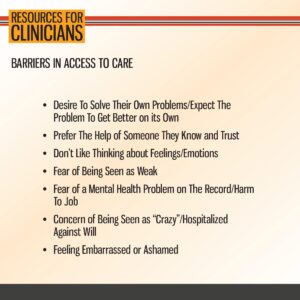
Additional barriers may include not knowing where or how to connect with a mental health professional, believing a therapist will not know how to help, or having prior bad experiences when seeking help. For example, “I sought help after spending a few years in a child sex crime unit. The counselor halted our visit on day one because she could not handle what I was talking about.” First responders may believe that treatments will be “touchy feely” or focused on medications. They may have concerns with the cost or confidentiality of therapy and may struggle to find time in their already demanding schedules.
3. Interventions
Audio
Transcript
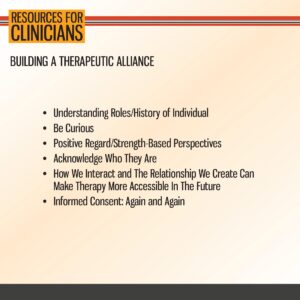
Building a Therapeutic Alliance
Addressing the concerns and barriers to therapy is a primary need when building a therapeutic relationship with a first responder. Trust can be slow to build but the more prepared the therapist is to work with a first responder, the more likely the success. Maintaining a strong positive regard for the individual and their willingness to come into therapy, as well as utilizing strength ‑based perspectives from the initial meeting will help build rapport. Acknowledge their inherent resilience, desire to help and the sheer perseverance required to do the work. First responders carry a weight unknown by most and deserve to have this recognized! Acknowledge that they are more than their job. Be prepared to complete thorough history taking but know some information will come with time. Be curious about how they got into the work, and why it is important to them. Ask how did you learn to build the skills (including walls) needed for your job?
The clinician sets the tone for the relationship and can “make or break” someone’s willingness to reach out again. It is important to find a balance between the authoritarian and direct approach of their work culture, and the attunement and empathy necessary in the therapeutic environment. For example, therapy can be how a first responder takes care of themselves to ensure they are “duty-ready” instead of feeling that they need to be “taken care of.” Focusing on language around safety vs. care is so important (ie. How are you mentally safe, physically safe). This relates to the first responder themselves as well how they talk about their family members.
Get informed consent and continue to clear up any concerns related to confidentiality, at every reasonable opportunity. If they are referred to treatment by a supervisor or as part of a workman’s compensation claim issues around confidentiality and release of records should be addressed in the beginning of treatment and as they arise thereafter. Make sure you are on the same page regarding who their files are released to and for what purposes they may be used. It’s essential that you are direct about every aspect of confidentiality, including the contents of their record, what is and isn’t released, who information is shared with, and the right to withdraw consent for release at any time.
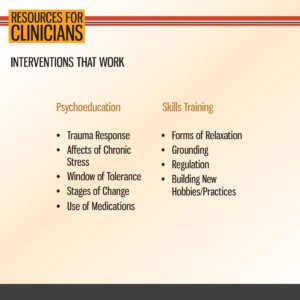
Interventions That Work
There are several evidence‑based therapy interventions that that are successful with first responders.
1) Although Psychoeducation is often a part other treatment modalities, the importance of this component of treatment should not be overlooked. Providing first responders with information regarding how the brain and body manages chronic stress, trauma and dissociation can open the door to accepting therapy. It can help move someone from “what’s wrong with me” to understanding that this is “what the brain does to protect me” or “this is why my thoughts and feelings got stuck”. Learning about the window of tolerance, stages of change and sensory triggers can help make sense of the negative self‑beliefs. Depending on the therapeutic relationship and the individual, discussing pros and cons of medication options can help someone evaluate the value of short‑ or long term‑ use. Peer support can mean many different things; co‑workers, friends, loved‑ones, and others they respect. Additionally, intra-departmental peer support access can be an option. Refer to Redline Rescue for intra‑departmental peer support resources.
2) Skills training is another important component of therapy, no matter what your therapeutic orientation or approach. The first responder may already have positive, healthy strategies they use to relax but they may not fully consider the benefit of engaging in these activities. Identifying these sources to build from, as well as exploring various other forms of relaxation and grounding practices can be useful. Helping a first responder understand how to regulate their emotions can help them feel more comfortable and confident in their work and personal life. Identification of triggers, increased self‑awareness and self‑compassion are all tools that can aid in increasing emotional regulation. Sometimes, enhancing time management skills can be helpful in creating space to engage in new hobbies or practices that will help increase work/life balance. Both helping someone identify interest and gain confidence in learning something new can assist in this process.
One important thing to note is that before a clinician introduces a modality that might be considered too touchy feely such as meditation, it is important to first understand the responders’ acceptance level of such modalities.
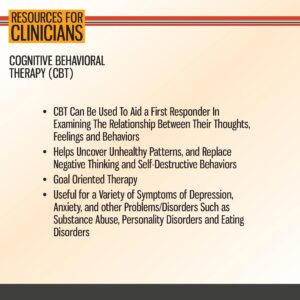
Cognitive Behavioral Therapy (CBT)
Cognitive Behavioral Therapy is a widely supported treatment modality that is both accessible and effective. It can be used to aid first responders in examining the relationship between their thoughts, feelings and behaviors; helping to uncover unhealthy patterns, and replace negative thinking and self‑destructive behaviors. A benefit of using CBT with first responders includes the structure of therapy. Because CBT is goal oriented, problem‑focused and addresses the immediacy of symptoms, it can be useful for those who cannot easily access the root of problem or traumatic memories. CBT can be helpful for a variety of symptoms of depression, anxiety, and other problems/disorders such as substance abuse, personality disorders and eating disorders that may be present in more complex cases. Recognizing the goal for treatment and mutually agreeing on the approach to reach that goal provides buy‑in and recognizes resiliency.
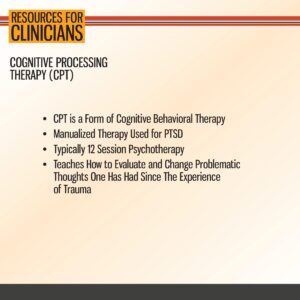
Cognitive Processing Therapy (CPT)
CBT is good but it is not enough if you don’t have a modality behind it. You cannot simply use “talk therapy” with first responders. Cognitive Processing Therapy (CPT) is one specific type of Cognitive Behavioral therapy. It is a 12‑session psychotherapy for PTSD. Clinicians use CPT to teach the client how to evaluate and change the upsetting thoughts they may have had since their traumatic experience. By helping them change their thoughts, they can change how they feel.
CPT is one of the evidence‑based treatments for PTSD and includes organizing one’s thinking through writing activities, examining those thoughts, and gives clients a way to step back and reflect on what actually transpired. CPT helps to develop balanced ways of thinking about things/incidences that may have been distorted in one’s mind and have become obstacles to healing from PTSD.
Other Therapy
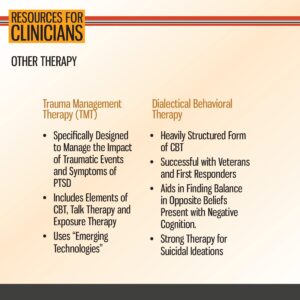
Trauma Management Therapy is a newer evidence‑based intervention that is specifically designed to treat PTSD and other trauma disorders. The focus of TMT is on skill building and uses exposure therapy to help identify fear and distress caused by certain triggers. Exposure is used to help desensitize from the distress over time in order to reduce fear responses. TMT uses virtual reality simulation to help with exposure strategies based on the individual’s specific treatment plan. Dialectical Behavioral Therapy is a form of heavily structured CBT that has been effective with veterans and first responders. Combining both talk and behavioral therapy to address negative emotions and learn strategies to cope with stress and increase communication skills, DBT focuses on Mindfulness, Distress tolerance, Emotional Regulation and Interpersonal Effectiveness. DBT can be a longer form of therapy and requires specific clinician training.
Mindfulness
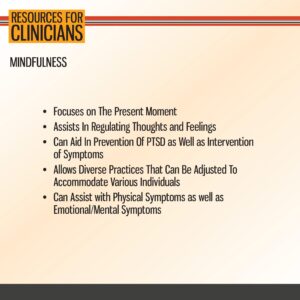
Mindfulness practice focuses on developing increased awareness of one’s physical, mental and emotional states without judgement of how or why that state exists. It can allow the individual to begin to accept what they think and feel ultimately allowing more control over cognition and behavior. While mindfulness is rooted in various (eastern) spiritual/philosophical beliefs there are several interventions (such as Acceptance Commitment Therapy/ACT) that are designed for the therapeutic environment. Though, many forms of therapy include some mindfulness activities such as breathing, guided imagery and grounding exercises. First Responders may find an intentional practice such as yoga or meditation helpful as well. There are various forms of both with specific disciplines and focus that a first responder may find beneficial.
Treatment Planning: Skill Building
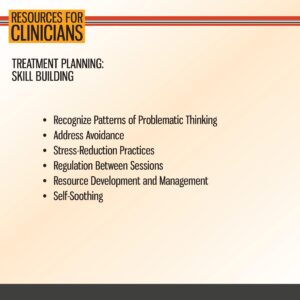
Clinicians should be prepared to provide psychoeducation on avoidance strategies when they are present and teach first responders to develop awareness of when they use avoidance to cope with feelings. First responders may need help in creating new active coping strategies, stress relief practices, and identifying sources of fear and anxiety. Consider exposure exercises that may create comfort with feeling emotions and sensations that normally would be avoided.
Stress reduction practices taught within session are more likely to be used outside of session, particularly in the beginning stages of therapy. Have several imagery relaxation activities, muscle relaxation therapies or mindfulness/regulation therapies available for consideration. Thought field tapping, diaphragmatic or other breathing exercises, and 54321 activities can easily be incorporated into session until the responder builds comfort using these strategies on their own. When introducing new stress reduction, relaxation and self‑soothing activities it is important to fully consider the individual and their likelihood to accept and use the tools being taught to them. For example, for someone highly creative and somewhat comfortable with their emotions guided imagery may be more successful than for someone resisting therapy or reluctant to let down defenses.
4. Additional Resources
Audio
Transcript
Clinician Competencies
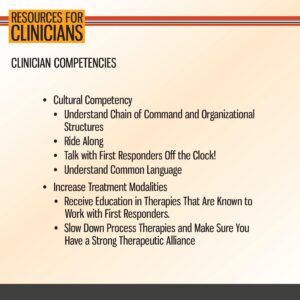
First responders are more likely to respond to therapy with someone who understands their work. For this reason, it is crucial for clinicians to expand their knowledge of the roles and responsibilities of the first responders being served. Understanding the structure, shifts, and lifestyle demands of first responders not only improves confidence in the clinician but allows better treatment planning and direction in therapy. There are several ways to increase this knowledge outside of the therapeutic environment:
“Ride alongs ” with first responders allow the clinician to immerse themselves in the everyday world and experiences of their clients. Developing relationships with local agencies or participating in a program like a “citizen’s police academy “can provide opportunities for ride alongs. Each department is different and most require waivers due to the nature of lived experience. Be prepared to understand the expectations and met all requirements before agreeing to ride along.
Talk with first responders off the clock! Find first responders who are willing to provide interviews and share casual conversation about their work. Clinicians should not expect that their clients provide this education in session. While therapy always provides an opportunity to learn the individual and their perceptions, it is not the place for general education when working with this population. Learn common langue or “lingo ” so as not to interrupt processing when it is not necessary.
Clinicians should consider increasing their therapeutic toolbox by learning modalities that have proven successful when working with first responders. Being able to build evidence-based practices into treatment based on the individual’s needs can require utilizing several components of therapy. A clinician’s competence in multiple interventions can increase success of therapy with first responders.
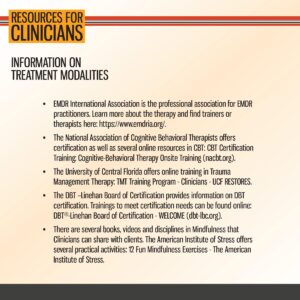
Information on Treatment Modalities
The above resources can be utilized to learn more about specific evidence‑based interventions. Most of these interventions offer basic and advanced training as well as training specialized for clinicians working with first responders.
Additional Resources
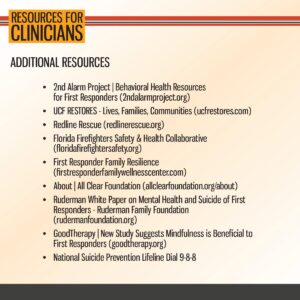
Links to these resources are included below.
Resource Links
2ndalarmproject.org
UCFrestores.com
Redlinerescue.org
Floridafirefightersafety.org
Firstresponderfamilywellnesscenter.com
Resources
Please feel free to review additional modules in this Toolkit for more resources and information on first responder mental wellness.