BHAP Overview – Lance Butler
Transcript
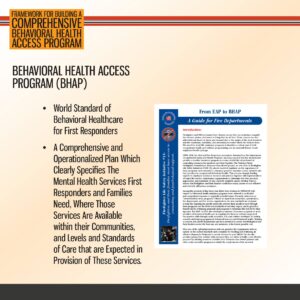
Hello, my name is Lance Butler, Engineer/Paramedic with the Tallahassee Fire Department and Tallahassee Fire Department peer support team leader. A Behavioral Health Access Program, or a BHAP for short, is a comprehensive and operationalized plan which clearly specifies the mental health services first responders and their families may need, where those services are available within their communities, and levels and standards of care that are expected from these services. Its purpose is to ensure education, support, assessment, and intervention for members who may be affected by behavioral health issues. The BHAP has been recognized by the National Fallen Firefighters Foundation as a best practice and is becoming a world standard of behavioral healthcare for first responders. This module will provide a high-level overview of BHAPs for first responders and their families.
Other Modules
BHAP Framework – Course Chapters
1. BHAP Objectives and Overview
Audio
Transcript
Framework for Building a Comprehensive Behavioral Health Access Program
Framework for building a comprehensive behavioral health access program. In this module, we will be taking you through the framework for building a Comprehensive Behavioral Health Access Program, or BHAP for short. You will learn the components, how they are integrated, and some of the science behind the move to this inclusive, evidence-based model.
The vision for the development of a BHAP is to provide a comprehensive plan of programs and services available to first responders and family members facing a mental health issue of any scope.
First responder organizations may encounter significant difficulties in implementing behavioral health initiatives without a clear and operationalized framework.
This Toolkit is a guide to help overcome challenges and barriers to developing and implementing your BHAP.
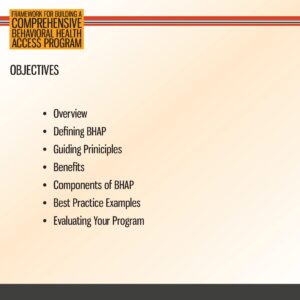
By the end of this module, you will be able to:
First, define BHAP and understand its purpose in promoting the mental health and well-being of individuals within your agency.
Second, identify the guiding principles of a BHAP and understand their importance in developing and implementing an effective program.
Third, recognize the benefits of a comprehensive BHAP, both for individuals seeking support and for the first responder agency as a whole.
Fourth, understand the key components of a BHAP and how they work together to create a comprehensive program that supports the mental health and well-being of individuals.
Fifth, explore best practice examples of existing BHAPs and understand how they have successfully implemented key components and guiding principles to support the mental health and well-being of individuals.
Lastly, learn how to evaluate your own BHAP and identify areas for improvement or adjustment to ensure the program is meeting the unique needs of individuals and the community or first responder agency.
By the end of this module, you will have a comprehensive understanding of each of these objectives and be equipped with the knowledge and tools necessary to build and evaluate a BHAP that promotes the mental health and well-being of individuals within your agency.
Defining BHAP
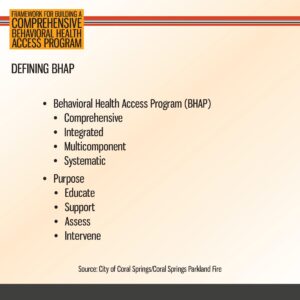
A Behavioral Health Access Program is a comprehensive, integrated, multi-component, systematic program pertaining to your members’ mental health, wellness, and crisis intervention. This program is designed to be a multifunctional approach with the understanding that there is no “one size fits all” approach to your member’s mental wellness.
The purpose of a Behavioral Health Access Program is to provide education, support, assessment, and intervention for employees who may be exposed to and/or affected by behavioral health issues.
This systemic approach is effective within the first responder community during the assessment phase, basic counseling, and within stress crisis interventions. A multifunctional system allows your members to receive the most beneficial assistance.
Behavioral Health Access Program (BHAP)
The BHAP model is emerging as a world standard of care for comprehensive first responder mental wellness and resiliency.
As outlined in the National Fallen Firefighters foundations guide “from EAP to BHAP,” this comprehensive approach allows agencies to tailor programs to their specific needs by addressing leadership, training, peer support, and education.
Traditional programs, such as EAP, are often found to fall short in terms of the overall need of the first responder. Some of these programs are difficult to navigate, may lack the necessary cultural competency, and often carry a negative stigma. This negative stigma can be in the form of ineffective care, agency mandated attendance, and trust issues surrounding the program. Building a program that encompasses trusted members with the training and skills to navigate your resources can increase the use of these resources.
Program Development Guiding Principles
Developing and implementing a BHAP can be time-consuming and overwhelming, particularly for departments with limited internal resources such as staff, funding, and support from leadership; as well as external resources such as clinical and community-based organizations.
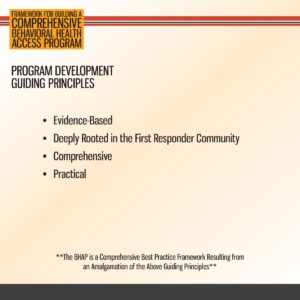
Utilizing the guiding principles listed here while developing and customizing your BHAP will allow you to maintain a compass on which to base your decisions. There may be nuances throughout your BHAP that are unique to your organization. Still, if you hold these principles, you will begin to develop an effective program most beneficial to your members.
The first principle in evidence-based practice. Evidence-based practice includes the integration of the best available evidence, professional expertise, first responder values and circumstances related to service delivery, program development, and policy/decision-making. All three of these elements are equally important.
The second principle involves being integrated within the first responder community. Being profoundly informed by the needs and characteristics of the population goes far beyond basic cultural competency. Through systematic evaluation and feedback, programs must continually assess for ground truth, the pulse of the first responder community, to help inform and drive program development and design.
The third guiding principle is the creation of a comprehensive program. To be successful, a BHAP must provide a wide range of services and resources, including prevention, early intervention, treatment, postvention, wrap-around care, and follow-up. These services should be available at all stages of a first responder’s career, from cadet programs and academy training through to retirement. It’s also essential to involve families and retirees, ensuring that everyone who may be impacted by behavioral health issues has access to the resources they need. By taking a comprehensive approach, you can ensure that your members have the support they need at every stage of their career and beyond. Finally, A BHAP must provide practical resources that are easy to access and use. If a program is too impractical to maintain, it won’t be effective. Therefore, it’s essential to deliver user-friendly resources that are delivered in a culturally competent and customizable fashion. This approach ensures that your members and their families can access the help they need quickly and efficiently, reducing the impact of behavioral health issues and improving overall wellness.
What’s the Goal?
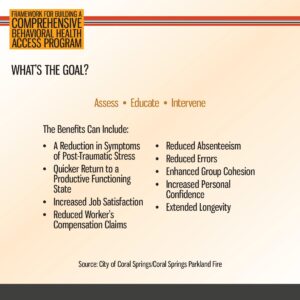
The goal of any BHAP is to assess, educate, and intervene as necessary to provide individuals with the tools and support needed to reduce the effects of a critical incident or daily stress, and to return to their work and daily lives. The benefits of a comprehensive BHAP are significant and can include a reduction in symptoms of post-traumatic stress, a quicker return to a productive, functioning state, increased job satisfaction, reduced worker’s compensation claims, reduced absenteeism, reduced errors, enhanced group cohesion, increased personal confidence, and extended longevity in the first responder role.
The BHAP Framework
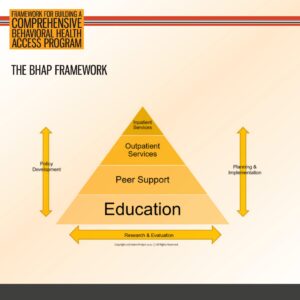
The 2nd Alarm Project has worked collaboratively with state and national subject matter experts to create the first peer-reviewed and published BHAP framework for first responder agencies. This figure illustrates the framework. The 2nd Alarm Project team developed this pyramid framework to conceptualize and organize the needed components of the BHAP for departments to use as a blueprint when designing and implementing a program. Each layer of the pyramid facilitates and supports the adjacent layers. In addition, the layers are flanked on each side by the crucial elements of policy development, planning and implementation, and research and evaluation.
2. BHAP Components
Audio
Transcript
BHAP Components
The individual components of a BHAP are listed below. Training, Critical Incident Outreaches, Chaplaincy, Outpatient/EAP, Leadership, Peer Support, Family Support, Inpatient/Recovery centers and appropriate trained clinicians each make up the whole. We will briefly identify some important points pertaining to each of these in this module, however, a more detailed examination will occur in individual modules of this Toolkit.
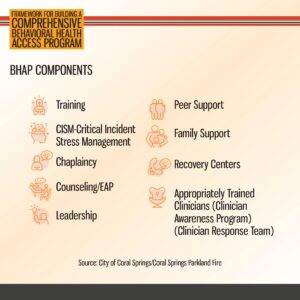
A true preventative measure is education. This is the foundation on which your BHAP should be built. If you provide early education that remains persistent throughout your member’s career, they will have the tools and resources to carry them through this career and life. Education is not relegated to the members in the field. Tailoring education to leaders, both agency-specific and throughout the municipality, will grow the understanding of first responders’ needs regarding mental wellness.
Including families in your educational program can produce long-lasting benefits for your organization. Even retirees can benefit from learning how to manage new stressors that come with life after their career. Early and often education is the key to maintaining the tools needed to not only survive this career but to also thrive. The Leadership section of this Toolkit has information on how to set priorities for your agency in choosing an educational curriculum. In addition, the Educational section provides more details about relevant education topics for your BHAP.

Peer Support
Peer Support is the heart of a resilient first responder organization and is one of the biggest keys to any BHAP program. It cannot be overstated how important it is to connect your members with others who have shared life experiences. Peers are the bridge between your members and your resources. This has become evident in recent years as peer support has become a staple in the first responder community. It is essential to create a program that employs a solid peer support component. Peer Support should span all ranks and be very diverse, understanding that the members will need someone they feel comfortable with to find the best connection. We will explore this further in the Building the Peer Support section of this Toolkit.
Even though they are not specifically mentioned in this section, Chaplaincy, Critical Incident Outreaches, and K9 Support are additional deployable resources that can be utilized to support the mental health and well-being of first responders.
Chaplaincy plays a vital role in many facets of an organization. It is invaluable to have a chaplain who can connect with first responders, deliver a ministry of presence, and serve the agencies, their families, and the community. More information on Chaplaincy can be found in the corresponding section of this Toolkit.
Critical incidents are an unfortunate reality that first responders are exposed to over the course of their careers. As more research becomes available on how, when, where, and why to handle these situations, best practices for the critical incident outreaches are also evolving. The Critical Incident Outreach section of this Toolkit provides more information on how to manage these incidents and support first responders. K9 Support has the ability to provide comfort and support to first responders during difficult and stressful situations. They are trained to provide emotional support and can help mitigate the effects of stress and anxiety. More information on K9 Support can be found in the corresponding section of this Toolkit.
Outpatient Services
Outpatient services include your EAP, health care, and clinicians within the community. It can be difficult for your members to sift through the countless options and land on one with whom they connect. There is an array of disciplines with which these clinicians work, and it is often confusing to know which one will be most effective within your agency. It can also be challenging to find clinicians who are culturally aware of the first responder community and what is truly needed.
Identifying these individuals can be a painstaking and daunting task; however, resources are available to assist you. There are also classes available for these clinicians to help them in learning the needs of the first responder community. More will be outlined in the Outpatient Services section of this Toolkit.
Inpatient and Residential Services
Inpatient and Residential Services are for your members that may need more help than outpatient services may provide. Inpatient services often deal with alcohol issues and other forms of substance abuse. These programs may also include intensive therapy for individuals who experience an acute mental health crisis. There are many options when trying to find effective inpatient services for your members. It is suggested that you vet these facilities prior to needing their services.
Knowing what insurance they take, what follow-up care looks like, what types of therapy they use, information about their recidivism rate, and if they have any specific programs tailored to first responders, and what those programs consist of are all questions that the facility should answer before referring members. There is more information on inpatient and residential services in that section of the Toolkit.
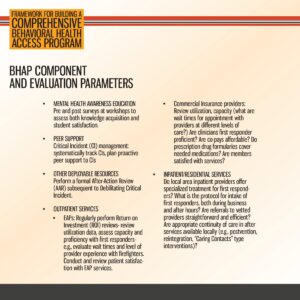
BHAP Components and Evaluation Parameters
Organizations should collaborate with partners, including community agencies and higher education to ensure all components of their BHAP is regularly updated and remains in alignment with evidence-based and clinical best practices for first responders needing behavioral health and substance use resources. Given that very few comprehensive BHAPs are currently in existence, directions for future research include working with departments as they conceptualize and implement their programs to establish evaluation parameters, including reliable and valid measures for pre and post outcome measurement on behavioral health issues of concern.
Researchers and leadership among organizations should partner to develop parallel planning, implementation, evaluation, and research design at the initial stages of conceptualizing the BHAP for their organizations. Such partnerships could produce a significant contribution to the knowledge base on BHAP including both quantitative and qualitative data collection elements to compare different types of BHAP models, measure potential benefits, identify best practices, and to follow feedback to continue strengthening programs and services for responders and their families.
3. BHAP Structure and Access
Audio
Transcript
Organizational Chart
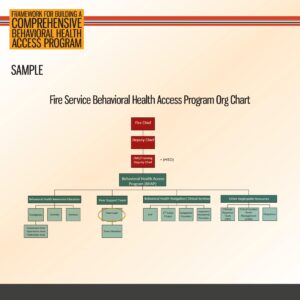
The organizational chart displayed is a sample in terms of what a fire department may use. Your organizational chart will look different depending on the size of your department, your specific profession, and where health and safety may fall within your organization. However, this is an excellent example of managing the span of control within your BHAP. This program can be overwhelming and reducing one person’s span of control will position this program up for success and longevity.
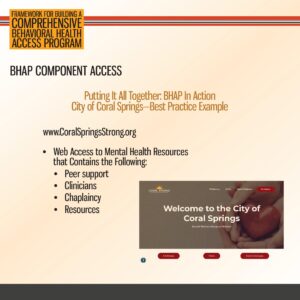
Throughout this Toolkit we reference the BHAP developed by the City of Coral Springs, Florida. This is a model best practice program and an invaluable resource for departments wishing to start or enhance existing programs. More information may be found at coralspringsstrong.org
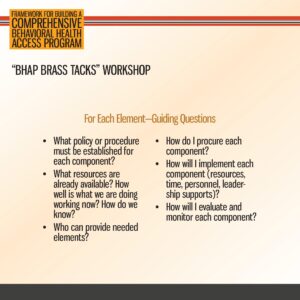
BHAP Brass Tacks Workshop
The 2nd Alarm project provides capacity building and technical assistance for organizations wishing to begin or augment their BAP programs. We offer a “Brass Tacks” workshop that guides participants through the BHAP framework. The following are basic questions to consider when beginning your journey to building your BHAP:
- What policy or procedure must be established for each component?
- What resources are already available?
- How well is what we are doing working now? How do we know?
- Who can provide needed elements?
- How do I procure each component?
- How will I implement each component (resources, time, personnel, leadership, supports)?
- How will I evaluate and monitor each component?
- For more information on capacity building for BHAPs, please visit 2ndalarmproject.org.
Resources
Thank you for taking the time to watch the BHAP preview. We invite you to navigate through the additional sections of this BHAP Toolkit.